 1Like


What are the best apps to learn Japanese?

🔎 Key points to consider before choosing a Japanese learning app:
📌 Our top picks of best apps to learn japanese:
|
Content Table
Duolingo’s gamified streaks are great for building a daily habit, but Japanese brings three writing systems, pitch accent and layers of politeness that most general language apps only scratch the surface of. If you’ve hit a wall with an app before, you’re not alone.
In this guide, we compare the best apps to learn Japanese in 2026: what each one is genuinely good at, where it falls short, and how to combine a couple of them into a routine that actually works. There’s no single best app to learn Japanese that works for everyone, which is exactly why we’ve tested and compared ten of the top options below.
Whether you’re after the Japanese alphabet, conversational skills or exam-ready vocabulary, you’ll find a clear pick below, and for anyone who’d rather skip the trial and error, pairing an app with a Japanese tutor who can correct your pronunciation in real time tends to get people speaking much faster.

How to choose the right app for you
With ten options on this list, narrowing them down comes down to being honest about what you actually need. Japanese asks more of an app than most languages, between three writing systems, pitch accent and layers of politeness, so the “best” app really depends on which part of that challenge you’re trying to solve first. Here are five things worth checking before you commit to one.
- Define your goal: someone prepping for a trip to Tokyo needs very different vocabulary and pacing to someone studying for the JLPT, learning for work, or picking up Japanese to understand anime and manga without subtitles,
- Think about your learning style: gamified repetition suits people who need streaks and small wins to stay consistent, while others get more out of structured grammar explanations, flashcard-based memorisation or live conversation with a real person,
- Check what the app actually teaches: hiragana and katakana are the two phonetic scripts you’ll need early on, kanji is a separate and much bigger undertaking, and very few apps genuinely cover both well in one place,
- Compare pricing and free trials: subscription costs vary considerably between apps, and most offer a free tier or trial period, so it’s worth testing two or three before settling on one and paying upfront,
- Read recent reviews: app store ratings and comments in learner communities, such as language-learning forums and subreddits, tend to give a far more realistic picture of what daily use actually feels like than marketing pages do.
The best apps to learn Japanese in 2026
Here’s our pick: ten apps and platforms covering everything from daily habit-building and kanji drills to structured grammar and real human tuition, so you can match the right tool to how you actually want to learn, whether that’s five minutes a day or a proper conversation with a tutor.
1. FindTutors; best for learning Japanese with a real tutor
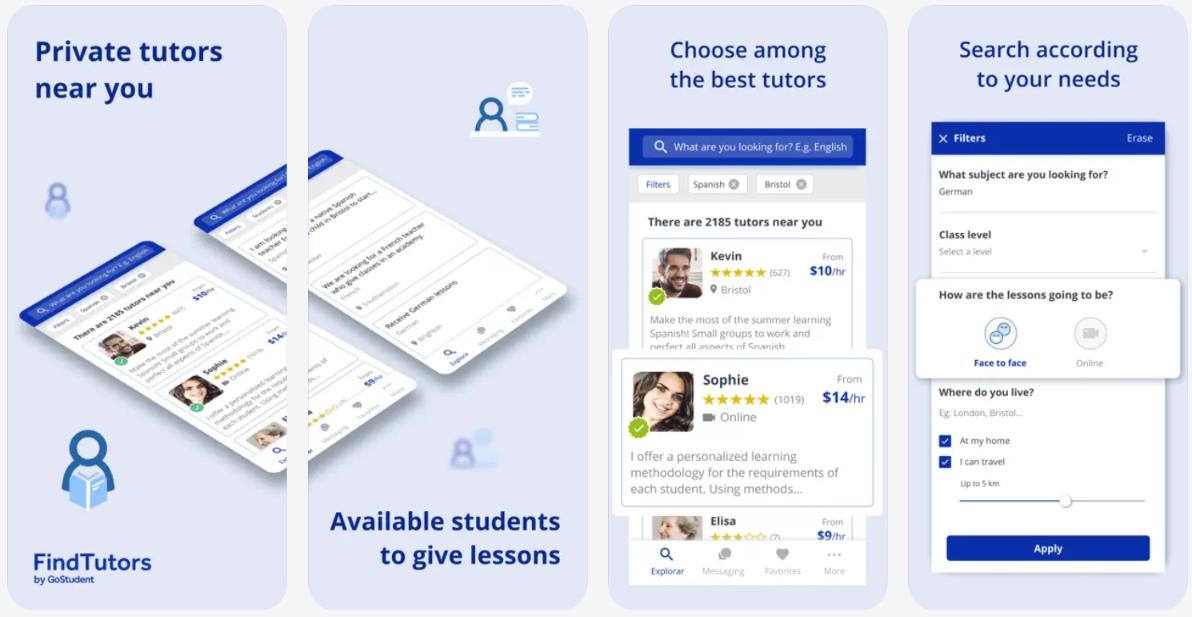
FindTutors is a UK tutoring marketplace that connects you directly with private Japanese tutors, for one-to-one lessons online or in person. It’s a different approach entirely to a self-study app: instead of fixed lessons, you work with a person who adapts to your level, corrects your mistakes on the spot and answers the “why” questions an app can’t.
Find an in-person japanese tutor
FindTutors app features:
- Direct messaging with tutors before you book, so you can compare approaches and ask questions upfront,
- Filters by price, availability, location and tutor experience,
- Verified Tutor badges and validated student reviews on every profile,
- Free trial lessons offered by many tutors,
- Both online and in-person lesson formats, depending on the tutor.
Who is this app best suited for?
FindTutors suits learners who’ve tried a self-study app and plateaued, especially those preparing for a trip, an exam or a specific conversational goal who need real feedback rather than more flashcards. It also works well for complete beginners who want someone to explain hiragana and basic grammar properly from the start, rather than guessing from pattern repetition. Less suited to learners who just want a free, no-commitment daily habit tool.
For anyone chasing real speaking ability rather than just recognising words on a screen, FindTutors is often the best app to learn conversational Japanese, since lessons are built around dialogue with a real person from day one.
Pricing:
- Free to browse profiles and contact tutors, no subscription required,
- Lesson prices are set by each tutor and typically start from around £10–15/hour, rising to £30/hour or more for experienced or specialised tutors,
- FindTutors takes no commission, so the price you agree is the price you pay.
Pros:
- No subscription needed to get started,
- Full flexibility on format (online or in person) and schedule,
- Learning adapts to you, rather than you adapting to a fixed curriculum,
- Verified tutor badges and validated student reviews help you choose with confidence.
Cons:
- No gamified daily habit tool, so self-discipline between lessons is on you,
- No built-in virtual classroom or lesson-summary tools,
- Costs more per session than a typical app subscription.
2. GoStudent ; best for structured, fully online lessons with a qualified tutor
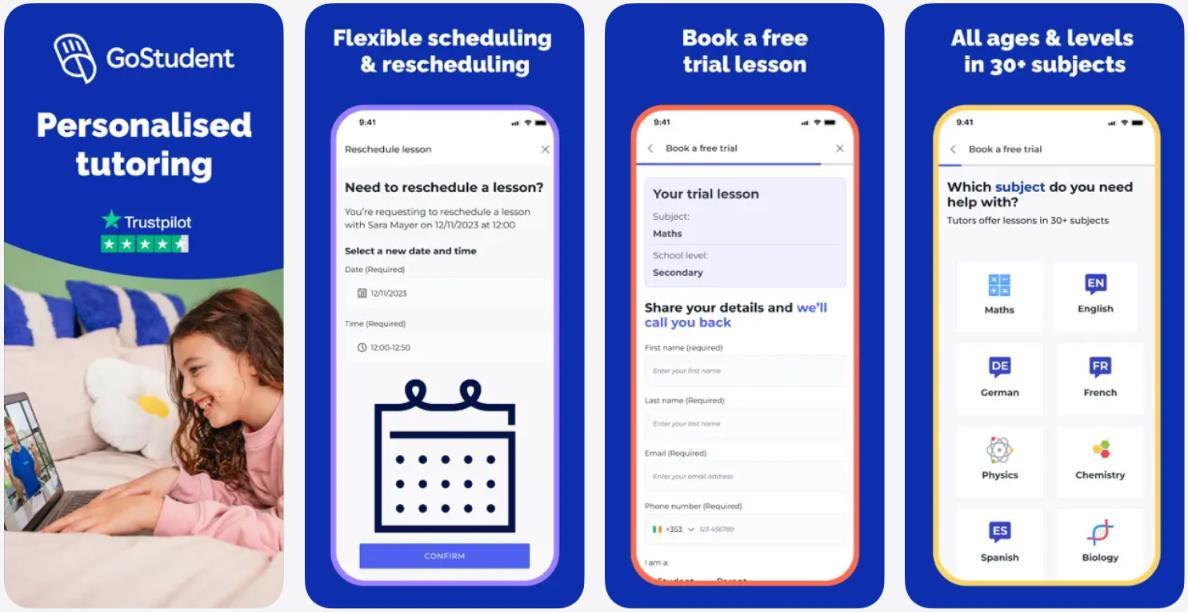
GoStudent is an entirely online 1:1 tutoring platform built around GoClass, its interactive virtual classroom, and it does offer live Japanese tutoring in the UK. Lessons are 50 minutes, tutors are selected through a rigorous process (only 8% of applicants are accepted), and every session comes with an automated lesson summary sent afterwards.
GoStudent app features:
- GoClass virtual classroom with a digital whiteboard, screen sharing, note-taking and an equation editor,
- Automatic lesson summaries and progress tracking after every session,
- Tutor matching based on level, goals and learning style,
- Lesson recording and playback,
- A free, no-commitment trial lesson.
Who is this app best suited for?
GoStudent works best for school-aged students who want Japanese alongside their regular curriculum subjects, and for parents who value structure, vetted tutors and visible progress tracking over flexibility. Several current tutors hold JLPT certification (N3 or higher) and have lived or studied in Japan, which suits beginners through to GCSE or A Level level. It’s less suited to adult learners wanting casual, pay-as-you-go lessons or in-person tuition.
Pricing:
- Subscription-based, sold in lesson packages rather than pay-as-you-go,
- Japanese lessons start from around £21.99 per class, varying by tutor and lesson volume,
- A free trial lesson is included before you commit.
Pros:
- A genuine human tutor, several with JLPT certification and direct experience living in Japan,
- Structured, trackable progress with automated lesson summaries,
- Rigorous tutor vetting (DBS checks, competency tests),
- Flexible scheduling, seven days a week.
Cons:
- Online only, no in-person option,
- Subscription commitment rather than pay-per-lesson flexibility,
- Fewer Japanese tutors available than for core curriculum subjects like Maths or English, so booking slots at peak times may take more notice.
3. Duolingo: best for building a daily habit
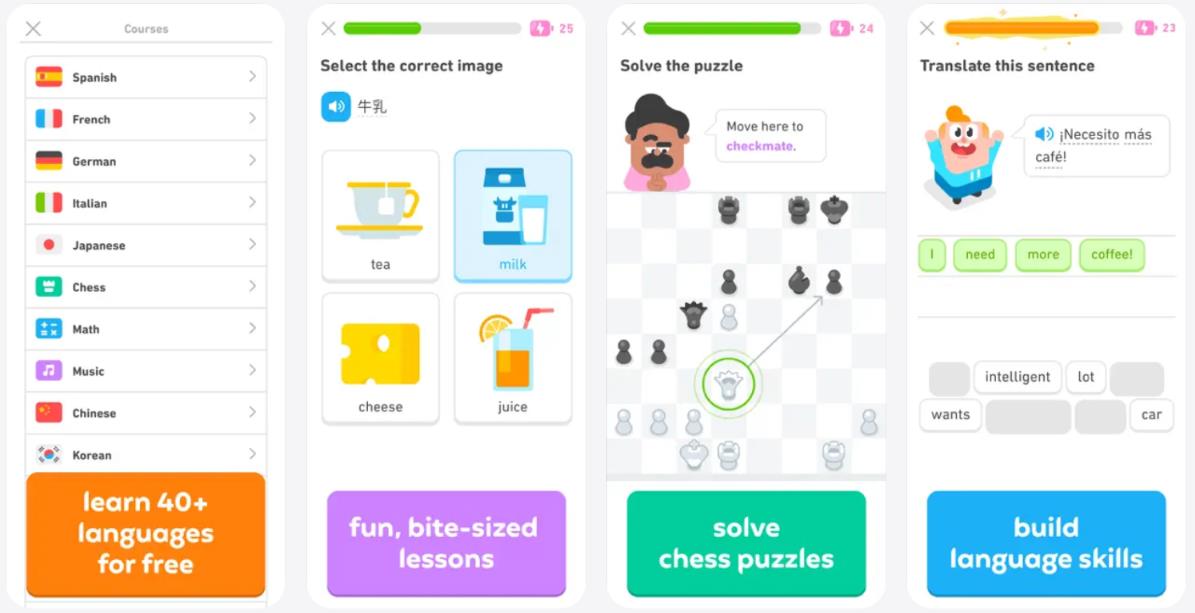
Duolingo is the free, gamified app most people try first. Short, game-style lessons cover basic vocabulary, sentence structure and all three Japanese scripts, hiragana, katakana and some kanji, unlocking progressively as you go.
Duolingo app features:
- Bite-sized, game-style lessons covering hiragana, katakana and basic kanji,
- Streaks and daily reminders to build a study habit,
- Speech recognition for basic pronunciation practice,
- A free tier with full lesson access (ads included).
Who is this app best suited for?
Duolingo suits absolute beginners who want a low-pressure way to get familiar with the Japanese scripts and basic words before committing to anything more structured. It’s a good habit-building tool for five to ten minutes a day. It’s not built for people who want to actually speak or understand real Japanese quickly, as the sentence patterns and explanations only go so far.
Pricing:
- Free, with ads, full lesson access,
- Super Duolingo (ad-free, extra features): around £10 to £13 a month.
Pros:
- Free and easy to start, no prior knowledge needed,
- Builds a daily study habit through streaks,
- Covers all three Japanese scripts at a basic level.
Cons:
- Sentence examples are often unnatural and rarely reflect real conversation,
- Grammar is taught by repetition rather than explanation,
- Doesn’t meaningfully develop speaking or listening skills.
4. WaniKani: best for learning kanji systematically
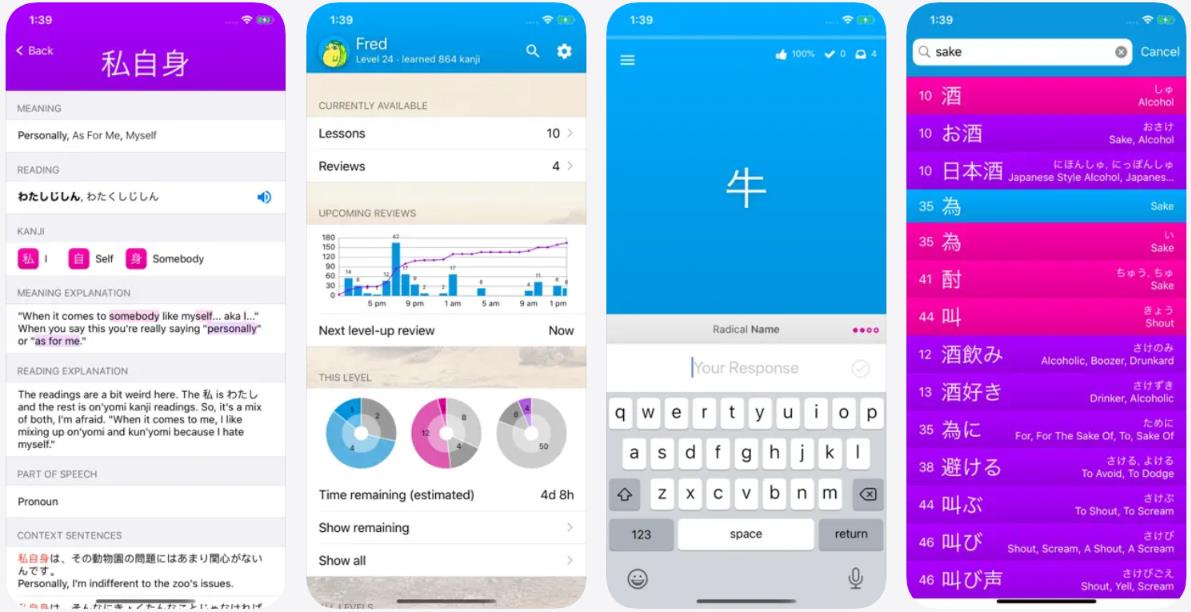
WaniKani is a web app built entirely around kanji, radicals and related vocabulary. It uses mnemonics and spaced repetition, starting with the smallest visual building blocks and layering new characters on top of what you already know.
Find intermediate level japanese tutors
WaniKani app features:
- Mnemonic-based spaced repetition system for kanji and vocabulary,
- Radicals-first structure that builds characters progressively,
- Level-by-level unlocking as you complete reviews,
- A free trial covering the first few levels.
Who is this app best suited for?
WaniKani is best for learners who already know hiragana and katakana and want a serious, structured method for tackling kanji specifically. It particularly suits people preparing for the JLPT who need reading comprehension to improve steadily over months. It’s not a fit for absolute beginners, or for anyone who also wants grammar or speaking practice covered in the same app.
Pricing:
- Free trial for the first three levels,
- Around £7 a month, or roughly £70 a year.
Pros:
- Systematic, level-by-level approach to kanji,
- Mnemonics make characters genuinely memorable,
- Builds real reading comprehension over time.
Cons:
- Strict progression, you cannot skip ahead or reorder content,
- Vocabulary covered isn’t always the most practical for daily conversation,
- No grammar, speaking or cultural content at all.
5. LingoDeer; best for a structured, beginner-friendly grammar course
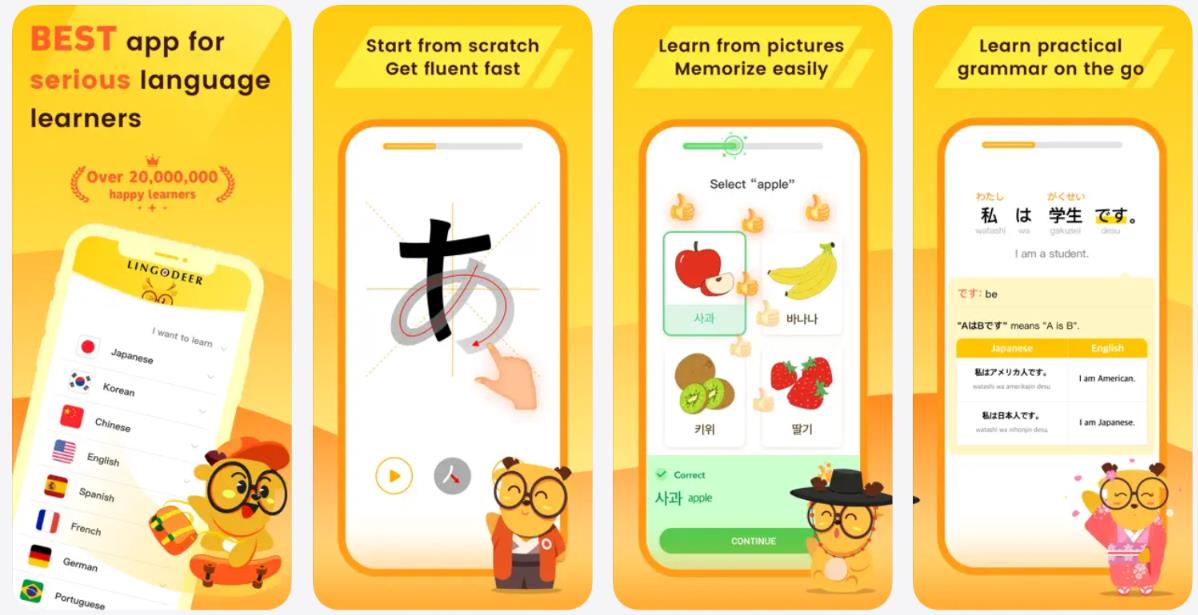
LingoDeer is a course-style app originally built around Asian languages, with Japanese as one of its strongest and most popular courses. Rather than isolated flashcards or games, it teaches grammar step by step with full explanations, similar to a well-paced classroom course.
LingoDeer app features:
- Structured grammar lessons with clear explanations, not just pattern repetition,
- Native-speaker audio throughout, with practical, natural dialogues,
- Covers hiragana, katakana and basic kanji alongside grammar and vocabulary,
- Offline lesson downloads for studying without a connection,
- A generous free tier before any payment is needed.
Who is this app best suited for?
LingoDeer suits beginners who want Japanese grammar explained properly from the start, rather than picked up through trial and error. It’s a strong pick for anyone who found Duolingo too shallow but isn’t ready for a dense textbook-style app. It’s less suited to advanced learners needing deep kanji study or JLPT-specific grammar drilling.
Pricing:
- Free tier with limited lesson access,
- Subscription from around £12 a month, with longer-term and lifetime options available at a lower effective cost.
Pros:
- Grammar is properly explained, not just repeated,
- Covers hiragana, katakana, basic kanji and vocabulary in one structured course,
- Natural, practical dialogues rather than disconnected sentences.
Cons:
- Less depth than dedicated kanji or grammar apps once you’re past beginner level,
- Subscription cost adds up compared to one-time-purchase alternatives,
- No live conversation practice.
6. Bunpro; best for structured grammar study
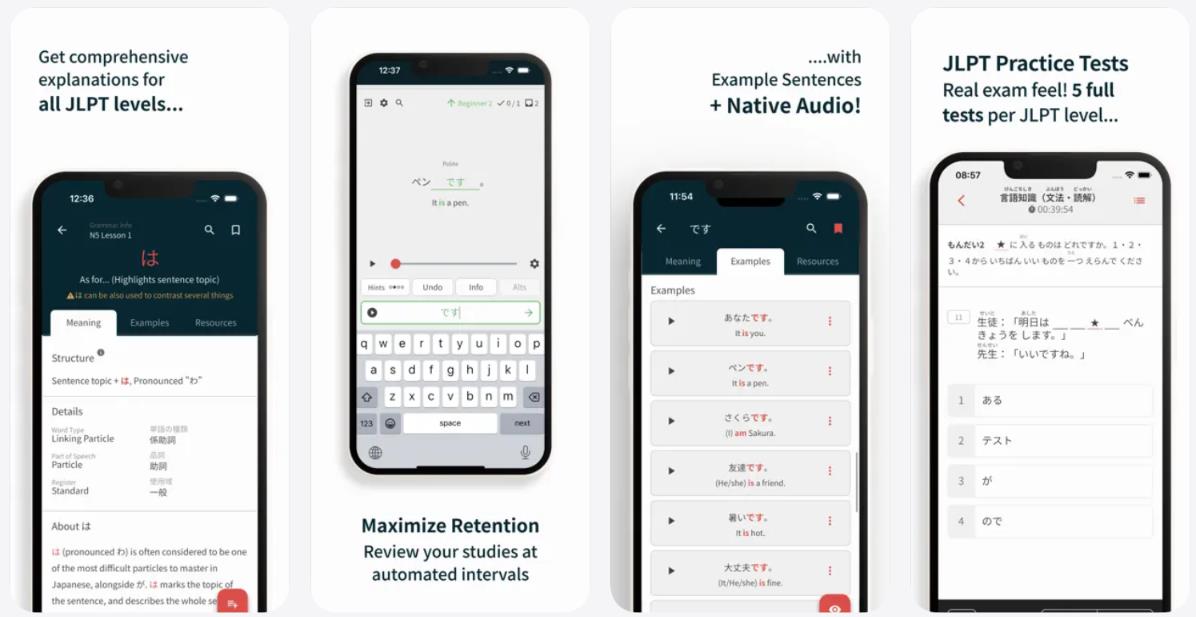
Bunpro is a grammar-focused app covering Japanese grammar points from beginner level through to advanced JLPT level. Each point comes with example sentences and detailed explanations, reinforced through spaced repetition reviews.
Bunpro app features:
- Grammar coverage from N5 through to N1,
- Example sentences for every grammar point,
- Spaced repetition reviews to reinforce what you’ve learned,
- Works alongside popular textbooks such as Genki and Tae Kim.
Who is this app best suited for?
Bunpro suits learners already following a textbook or a structured course who want their grammar reinforced and tested regularly. It’s particularly useful for JLPT candidates who need grammar drilled systematically rather than picked up incidentally. On its own, it won’t build speaking confidence, so it works best paired with conversation practice.
Pricing:
- Free tier with limited access,
- Around £4 a month for full access.
Pros:
- Comprehensive grammar coverage from beginner to advanced,
- Connects grammar points to real example sentences,
- Pairs well with textbook-based study.
Cons:
- Grammar study alone doesn’t build conversational fluency,
- Interface takes some getting used to,
- Works best as a supplement, not a standalone resource.
7. Renshuu; best free all-rounder
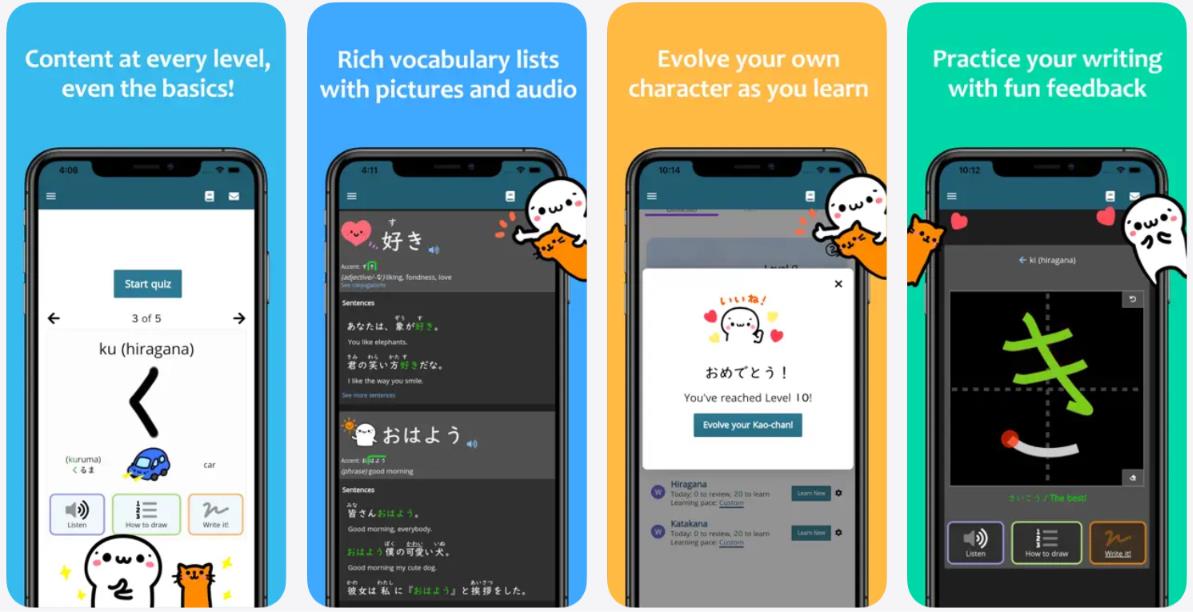
Renshuu combines vocabulary, kanji and grammar practice into one app, built around games, quizzes and a generous free tier. It’s designed to cover several skills at once rather than specialising in just one.
Renshuu app features:
- Vocabulary, kanji and grammar practice in a single app,
- Gamified quizzes and challenges to vary study sessions,
- JLPT preparation tools and progress tracking,
- A customisable study schedule based on your goals.
Who is this app best suited for?
Renshuu is a solid pick for beginner to intermediate learners who want one free tool covering several skills before investing in specialist apps. It suits people who like variety and gamification over a single, narrow focus. Learners wanting deep kanji mastery or detailed grammar explanations may eventually outgrow it and need a more specialised app.
Pricing:
- Generous free tier,
- Renshuu Pro: around £6 to £7 a month for extra features.
Pros:
- Covers vocabulary, kanji and grammar in one place,
- Strong free tier compared to most competitors,
- Gamified format keeps sessions varied.
Cons:
- Less deep than dedicated kanji or grammar apps,
- Interface and design feel less polished than premium alternatives,
- JLPT tools work best once you already have some foundation.
8. Rosetta Stone; best for visual, translation-free vocabulary
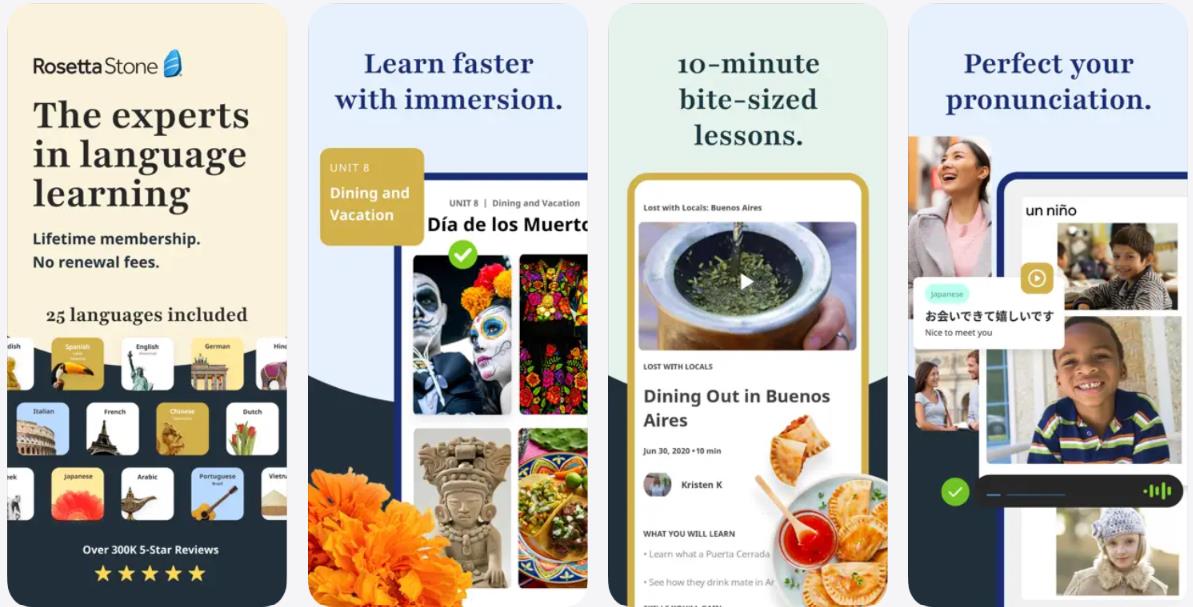
Rosetta Stone teaches Japanese through image and audio association rather than English translations. You see a picture, hear the word or sentence, and select the matching option, building vocabulary without relying on your native language.
Find beginner level japanese tutors
Rosetta Stone app features:
- Image-and-audio association with no English translations,
- Speech recognition for pronunciation feedback,
- Structured lessons with clear progression,
- Offline lesson downloads for studying on the go.
Who is this app best suited for?
Rosetta Stone suits learners who prefer an immersive, translation-free approach and want feedback on pronunciation as they go. It works reasonably well for building core vocabulary through repetition and visual association. It’s a weaker fit for Japanese specifically, since the method was designed around European languages and kanji is introduced late and shallowly.
Pricing:
- Around £12 a month, with a three-month minimum commitment.
Pros:
- Structured lessons with clear progression,
- Pronunciation feedback through speech recognition,
- No translations forces you to think in Japanese.
Cons:
- Image-association method suits Japanese less well than European languages,
- Grammar explanations are minimal,
- Kanji is introduced late and not covered in depth.
9. Pimsleur; best for hands-free audio learning
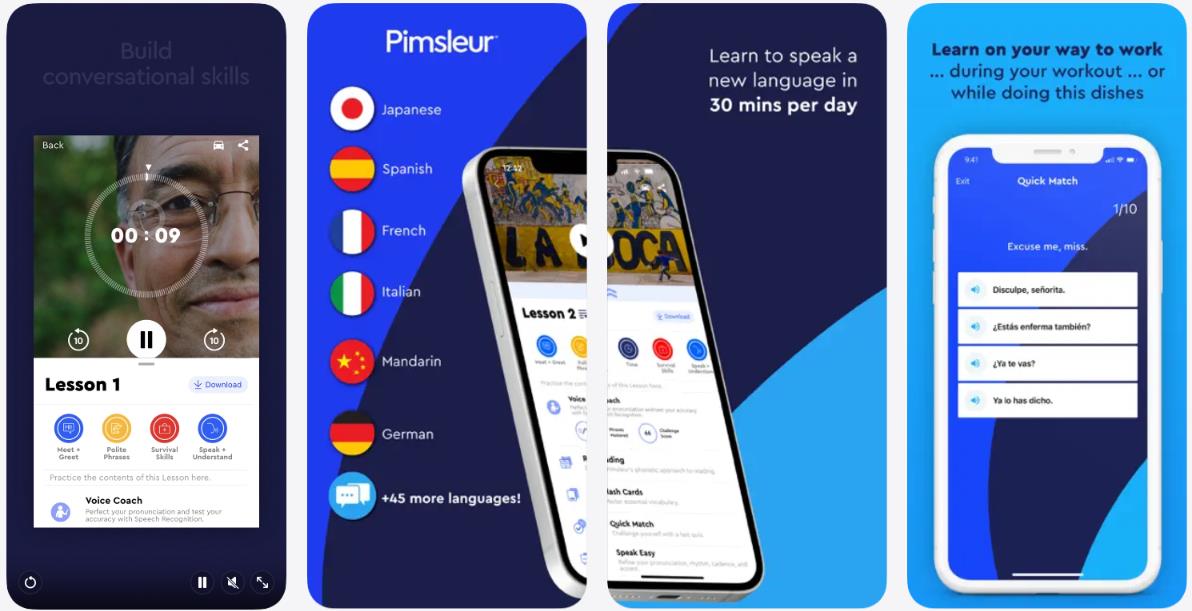
Pimsleur delivers Japanese through audio-only lessons you listen to and respond to out loud, without needing to look at a screen. Each session introduces words and phrases in a structured listen-and-repeat format.
Pimsleur app features:
- Fully audio-based, screen-free lessons,
- Structured listen-and-repeat format in every session,
- Consistent thirty-minute lesson length,
- Downloadable audio for offline use.
Who is this app best suited for?
Pimsleur suits commuters and multitaskers who want to fit Japanese study into drives, walks or chores without staring at a screen. It’s particularly useful for picking up natural pronunciation and listening comprehension early on. It’s not suited to anyone who also wants to learn to read or write, since reading isn’t part of the format.
Pricing:
- Around £17 to £20 a month.
Pros:
- Works entirely without a screen,
- Consistent format makes building a routine easy,
- Helps beginners pick up natural sounds and rhythm early.
Cons:
- Scripted, predictable responses limit real practice,
- Vocabulary coverage is narrower than structured lesson apps,
- Doesn’t teach reading or writing at all.
10. Tandem; best for conversation exchange with native speakers
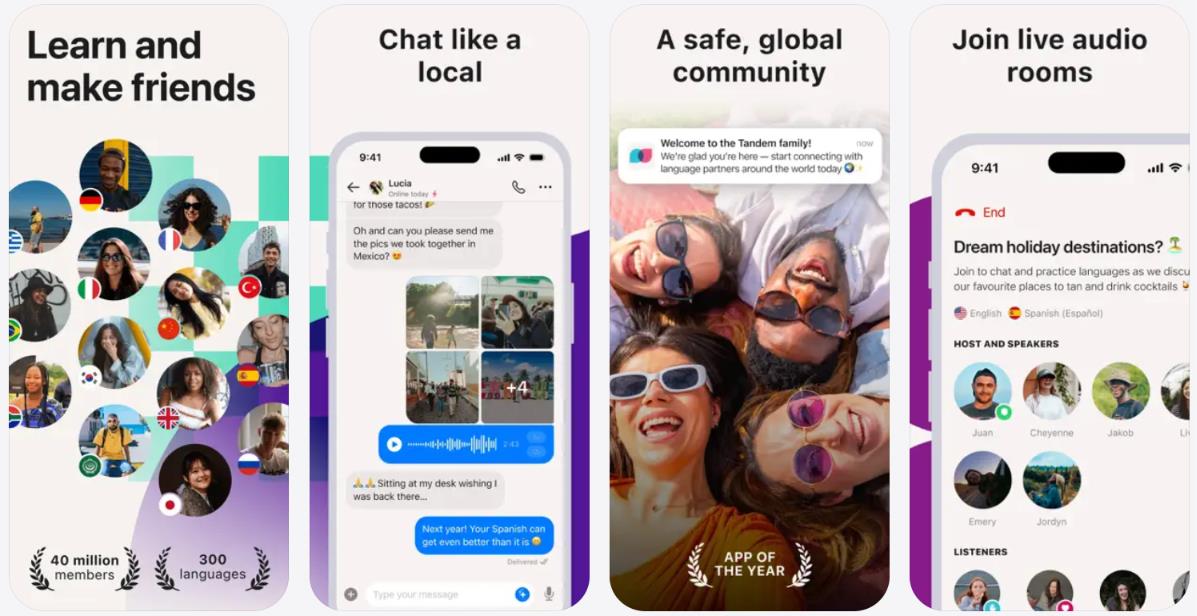
Tandem connects you with native Japanese speakers for free-form conversation practice, via text, voice or video chat. In exchange, you typically help your partner practise your own native language.
Tandem app features:
- Matching with native Japanese speakers for language exchange,
- Text, voice and video chat built into the app,
- Correction tools for messages and translations,
- A large, active global learner community.
Who is this app best suited for?
Tandem suits learners who already have some basic vocabulary and grammar and want genuine conversation practice, rather than more drills. It’s especially useful for building confidence speaking and picking up natural, informal phrasing. Complete beginners with no foundation at all tend to find exchanges frustrating until they have a bit more to work with.
For learners who already have some vocabulary and want to practise speaking for free, it’s frequently named the best app to learn conversational Japanese, since every session is a real exchange with a native speaker rather than a scripted drill.
Pricing:
- Free, with a community-driven exchange model,
- Tandem Pro: around £11 a month for extra features.
Pros:
- Real conversation practice with native speakers,
- Large, active community across many languages,
- Genuine cultural exchange alongside language practice.
Cons:
- Practice quality depends entirely on your exchange partner,
- No structure or curriculum to follow,
- Requires initiative to keep sessions consistent.
Conclusion; the best apps to learn Japanese in 2026
1. FindTutors
FindTutors stands out for anyone who’s hit a wall with self-study and wants real feedback. Working directly with a Japanese tutor means your mistakes get corrected as you make them, rather than reinforced through repetition. It’s our top pick for learners who are serious about reaching real conversational ability, not just recognising words on a screen.
2. GoStudent
GoStudent solves the same core problem as FindTutors, a lack of real feedback, but in a more structured, curriculum-style format. With vetted tutors, several holding JLPT certification, and built-in progress tracking through GoClass, it suits learners (and parents) who want accountability and visible structure alongside the human element.
3. Renshuu
For a genuine self-study app, Renshuu is the strongest all-rounder on this list. Rather than specialising narrowly like WaniKani (kanji only) or LingoDeer (grammar-focused), it covers vocabulary, kanji and grammar together, backed by a generous free tier. It’s the app we’d recommend pairing with a tutor for daily practice between lessons.
Combining a tutor, FindTutors or GoStudent, for speaking and feedback, with Renshuu for daily vocabulary and grammar practice, covers most of what Japanese throws at learners. Whichever combination you choose, the most important step is simply starting, and sticking with it, one lesson at a time.
Frequently asked questions on choosing a Japanese learning app
➕ What are the best apps to learn Japanese? |
|
FindTutors and GoStudent lead for learners who want real feedback from a human tutor, while Duolingo, WaniKani, LingoDeer, Bunpro, Renshuu, Rosetta Stone, Pimsleur and Tandem each specialise in one skill, from kanji to conversation. Most people get the best results combining two or three rather than relying on a single app. |
➕ What is better than Duolingo for Japanese? |
|
WaniKani is better for kanji, LingoDeer for structured grammar, and Bunpro for dedicated grammar drilling, since each goes deeper than Duolingo’s general approach. For real conversation and speaking confidence, a tutor through FindTutors or GoStudent tends to produce faster progress than any app alone. |
➕ What is the fastest way to learn to speak Japanese? |
|
Speaking from day one, rather than waiting to feel ready, makes the biggest difference. Pairing daily app practice for vocabulary and grammar with regular sessions with a native-speaking tutor, who corrects mistakes in real time, is generally the fastest route to real conversational ability. |
➕ How long does it take to learn Japanese using an app? |
|
It varies widely by goal and consistency, but most learners need many months of regular practice just to reach basic conversational ability using apps alone. Progress is usually faster when app study is paired with speaking practice, rather than relying on an app by itself. |
➕ Can I become fluent in Japanese using only an app? |
|
It’s unlikely. Apps are strong for vocabulary, kanji and grammar drills, but fluency depends heavily on real speaking practice, listening comprehension and cultural context that automated exercises can’t fully replicate. Most fluent learners combine app study with lessons, exchange partners or immersion. |
➕ Do I need to learn hiragana and katakana before using these apps? |
|
Not necessarily, several apps, including Duolingo, teach the two scripts from the very beginning. That said, having even a basic grasp of hiragana and katakana first makes it easier to get the most out of kanji-focused apps like WaniKani. |
Did you like this article? Share it now
Japanese tutor in Barcelona Ciudad specalised in offering online lessons classes adapted to the needs of each student. My classes are designed to help you reach your goals.
Teaches Catalan, Spanish, French, Photography, Maths, All courses, GCSEs and A Levels for adults, Physics, History, Latin, German, English as a foreign language and English Language classes
Use our Smart Finder