 1Like
1Like


Understanding Numerical Series and Their Real-World Applications Across Mathematics and Science
In mathematics, a numerical series is the sum of the terms of a sequence. While this might sound simple at first, the study of numerical series forms the foundation of countless areas in analysis, calculus, and even in applied sciences such as physics, computer science, and economics.
From the simple sum of integers to the complex infinite series that define exponential and trigonometric functions, numerical series are a powerful tool for understanding and approximating the behaviour of functions and real-world phenomena. If you're working through this topic with online maths tutors, this guide breaks the concept down step by step.
Content Table
- What Is a Numerical Series?
- Types of Numerical Series
- Convergence and Divergence in Numerical Series Explained
- Common Mistakes to Avoid in With Numerical Series
- Key Concepts for GCSE and A Level Maths
- Numerical Series in Real Life and their Applications
- Conclusion
- Frequently Asked Questions Relevant to Numerical Series
What Is a Numerical Series?
A numerical series arises when we take a sequence of numbers and sum them. For example, the sequence 1, 2, 3, 4, ... can be written as a series:
1 + 2 + 3 + 4 + ... + n
This is known as a finite arithmetic series. However, when the number of terms extends to infinity, we enter the domain of infinite series, which are particularly important in higher mathematics.
An example of an infinite series is the geometric series:
1 + 1/2 + 1/4 + 1/8 + 1/16 + ...
This series converges to 2, even though it has infinitely many terms.
Worked example:
Let's add the first five terms of this series step by step.
| Step | Running sum | Calculation |
|---|---|---|
| Term 1 | 1 | 1 |
| Term 2 | 1.5 | 1 + 0.5 |
| Term 3 | 1.75 | 1.5 + 0.25 |
| Term 4 | 1.875 | 1.75 + 0.125 |
| Term 5 | 1.9375 | 1.875 + 0.0625 |
Notice how the running sum keeps getting closer to 2 without ever going past it. This is exactly what a numerical series does when it converges: each new term adds less and less, and the total settles on a fixed value. This might seem paradoxical at first, but it demonstrates the remarkable behaviour of series and their ability to represent precise values even with infinite terms.
Types of Numerical Series
There are many types of numerical series, each with their own characteristics and applications. Understanding what makes each one distinct is the first step to knowing which formula or test to apply.
1. Arithmetic Series
An arithmetic series is formed by adding the terms of an arithmetic sequence, a sequence where each term increases (or decreases) by the same constant amount, called the common difference.
Example: 2 + 4 + 6 + 8 + ...
Here, the common difference is 2, each term is simply the previous term plus 2. This type of numerical series is always finite when summed over a set number of terms, and its sum can be calculated directly using the formula for the sum of an arithmetic series, without needing to add every term one by one.
2. Geometric Series
A geometric series is formed by adding the terms of a geometric sequence, where each term is found by multiplying the previous term by a fixed number, called the common ratio.
Example: 3 + 6 + 12 + 24 + ...
Here, the common ratio is 2, each term is double the one before it. Geometric series behave very differently depending on the size of the common ratio. If the ratio is between -1 and 1, the series can converge to a finite sum even with infinitely many terms, as shown earlier with the series that converges to 2.
3. Harmonic Series
A harmonic series is formed by adding the reciprocals of positive integers.
Example: 1 + 1/2 + 1/3 + 1/4 + ...
At first glance, this looks similar to a geometric series, since the terms keep shrinking. However, the harmonic series is a classic example of a numerical series that diverges, its terms don't shrink quickly enough to stop the total from growing indefinitely, even though the growth becomes extremely slow.
4. Power Series
A power series is a numerical series of the form: ∑ aₙxⁿ
where aₙ represents the coefficients and x is a variable. Rather than summing fixed numbers, a power series builds up a function term by term.
Example: the power series for eˣ is 1 + x + x²/2! + x³/3! + ..., and adding more terms gives an increasingly accurate approximation of eˣ for a given value of x.
Power series are especially useful because they let us represent complex functions like eˣ, sin(x), and ln(1 + x) as an infinite sum of simpler polynomial terms.
5. Taylor Series and Maclaurin Series
Taylor series and Maclaurin series are specific types of power series used to approximate functions using polynomials, built from the function's derivatives at a single point.
Example: the Maclaurin series for cos(x) is 1 - x²/2! + x⁴/4! - ..., which gives a very close approximation of cos(x) for small values of x using just the first few terms.
A Maclaurin series is simply a Taylor series centred at x = 0, making it a special case rather than a separate concept.
Convergence and Divergence in Numerical Series Explained
One of the key questions when studying a numerical series is whether it converges or diverges. These two ideas describe opposite behaviours, so it helps to look at them side by side.
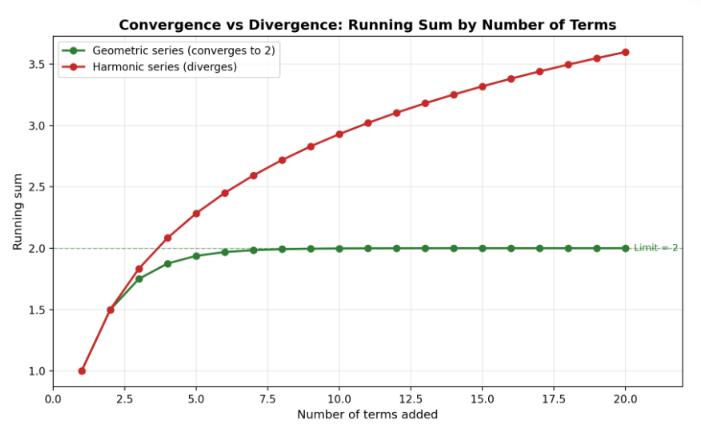
Convergence
A series converges when the sum of its terms approaches a fixed, finite value as more terms are added. No matter how many terms you include, the total never runs away to infinity, it settles closer and closer to one number.
Example: the geometric series 1 + 1/2 + 1/4 + 1/8 + ... converges to 2, as shown in the worked example above. Each new term is smaller than the last, so the running total flattens out instead of growing forever.
| Terms added | 1 | 2 | 3 | 4 | 5 | 10 | 20 |
|---|---|---|---|---|---|---|---|
| Running sum | 1.00 | 1.50 | 1.75 | 1.875 | 1.9375 | 1.998 | 1.999998 |
The running sum keeps inching towards 2 but never crosses it. That flattening curve is what convergence looks like in practice.
Divergence
A series diverges when its sum does not settle on a finite value, it either grows without bound or never stabilises.
Example: the harmonic series 1 + 1/2 + 1/3 + 1/4 + ... diverges. Even though each term gets smaller, the terms don't shrink fast enough, and the sum keeps growing forever, just very slowly.
| Terms added | 1 | 10 | 100 | 1,000 | 10,000 |
|---|---|---|---|---|---|
| Running sum | 1.00 | 2.93 | 5.19 | 7.49 | 9.79 |
Unlike the geometric example, this running sum never flattens out, it keeps climbing, just more slowly each time.
Convergence is tested using various tools like the ratio test, root test, comparison test, and integral test. These help determine whether a given infinite numerical series can be used in practical applications or not.
Start Taking In-Person Maths Tutoring Lessons
Common Mistakes to Avoid in With Numerical Series
A few misunderstandings come up again and again when learning about numerical series. Recognising them early makes the topic far easier to master.
Mistake 1: Assuming shrinking terms always mean convergence
It's tempting to think that if the individual terms of a series get smaller and smaller, the series must converge. The harmonic series (1 + 1/2 + 1/3 + 1/4 + ...) disproves this directly, its terms shrink towards zero, yet the series still diverges. What matters is not just whether the terms shrink, but how quickly.
Mistake 2: Confusing a sequence with a series
A sequence is an ordered list of numbers, such as 1, 2, 3, 4. A series is the sum of that list, so 1 + 2 + 3 + 4. Mixing up the two often leads to applying the wrong formula, for example using a sequence's nth-term formula when the question is actually asking for the sum of the sequence.
Mistake 3: Forgetting that an infinite series can have a finite value
It feels counterintuitive that adding infinitely many numbers together could ever produce anything other than infinity. But as shown with the geometric series converging to 2, an infinite numerical series can settle on a precise, finite total. Overlooking this leads students to dismiss convergence results as "impossible" rather than checking the working.
Mistake 4: Applying the wrong convergence test
Not every test works for every series. For example, the ratio test can return an inconclusive result for certain series, and stopping there without trying a second test, such as the comparison test or integral test, can lead to an incomplete or incorrect conclusion about convergence.
Mistake 5: Mixing up arithmetic and geometric series
Arithmetic series add a constant difference between terms, geometric series multiply by a constant ratio. Using the arithmetic sum formula on a geometric series (or vice versa) is a common exam error that produces a completely wrong answer, even when the rest of the working is correct.
Key Concepts for GCSE and A Level Maths
Numerical series appear at different depths depending on the level of study. This topic is most relevant to A Level Maths, where series and sequences form a dedicated part of the syllabus, though the basic building blocks start at Maths GCSEs.
At GCSE level, students are expected to:
- Recognise and continue arithmetic and geometric sequences,
- Find the nth term of a sequence,
- Understand basic sequence patterns without formal convergence testing.
At A Level, the topic goes further and students are expected to:
- Work with the sum of arithmetic and geometric series, including formulas for the sum of n terms,
- Understand and apply the concept of convergence for infinite geometric series,
- Use series in binomial expansions and, at a further level, in calculus through Taylor and Maclaurin series,
- Apply convergence tests where relevant, particularly for further maths modules.
For students preparing for exams, being comfortable with both the mechanical formulas and the underlying idea of convergence is what separates a solid grasp of numerical series from a superficial one.
Numerical Series in Real Life and their Applications
Numerical series are not just a theoretical tool, they are used extensively in many practical domains:
- Physics, series are used to model wave behaviour, electromagnetic fields, and quantum states. Fourier series, for example, represent periodic functions in terms of sine and cosine functions,
- Engineering, numerical methods rely on series expansions to solve differential equations, simulate circuits, and model fluid flow,
- Computer science, series approximations are used in algorithms that deal with numerical integration, simulations, and even graphics rendering,
- Finance, series help in calculating compound interest, analysing risk, and predicting trends using mathematical models.
Conclusion
Understanding numerical series opens a gateway to advanced problem solving in both pure and applied mathematics. They allow us to make sense of infinite processes, approximate complicated functions, and model the world around us.
Whether you're calculating a simple sum or working on a mathematical model of climate change, numerical series are likely playing a role behind the scenes. If you'd like structured support with this topic, private tutors can help build both the mechanics and the intuition behind it.
Frequently Asked Questions Relevant to Numerical Series
➕ What is the difference between a sequence and a series? |
| A sequence is simply an ordered list of numbers, such as 1, 2, 3, 4. A series is what you get when you add those numbers together, so 1 + 2 + 3 + 4 is the series formed from that sequence. |
➕ How do you know if an infinite series converges? |
| A series converges if its running sum approaches a fixed, finite value as more terms are added. This is typically confirmed using tests such as the ratio test, root test, comparison test, or integral test, depending on the type of series involved. |
➕ Why does the harmonic series diverge even though its terms shrink? |
| The terms of the harmonic series get smaller, but not quickly enough to stop the total from growing. Over enough terms, the sum keeps climbing without ever settling on a fixed value, which is why it diverges despite appearances. |
➕ At what level is this topic taught in the UK curriculum? |
| The basics of sequences appear at GCSE level, including arithmetic and geometric patterns. The deeper study of series, including sums to infinity and convergence, is covered at A Level, particularly within Pure Maths and Further Maths. |
➕ Where are numerical series used outside of mathematics classrooms? |
| They appear in physics for modelling waves and fields, in engineering for solving differential equations, in computer science for numerical algorithms, and in finance for compound interest and risk calculations. |
Did you like this article? Share it now

Marjolin Jahja
(49)
English Language tutor in London specalised in offering online lessons classes adapted to the needs of each student. My classes are designed to help you reach your goals.Contact
Teaches Physics, Applied Mathematics, Maths, Algebra, Primary school, Secondary school, GCSE, University, Programming, Probability and Statistics, After-school tuition and SATs classes
Contact
Use our Smart Finder