 Like
Like


Understanding Fuzzy Functions
When we learn traditional mathematics in school, we are taught to think in black and white: something is either true or false, one or zero. But what happens when we face problems in the real world that are not so clear-cut? That's where fuzzy logic and fuzzy functions come in.
Fuzzy functions are an extension of classical mathematical functions designed to deal with vagueness and uncertainty. Unlike traditional sets that have crisp boundaries, fuzzy sets allow elements to belong to a set with varying degrees of membership. This concept, introduced by Lotfi Zadeh in the 1960s, opened a whole new branch of mathematics that helps us handle imprecise information in a structured way.
If you're exploring this topic, this guide breaks fuzzy functions down step by step. And if you would love to know more about fuzzy functions, why not book a few lessons with with an online maths tutor to learn all about this mathematical concept?
Content Table
- What Are Fuzzy Functions?
- Types of Fuzzy Functions Explained
- Real-World Applications of Fuzzy Functions
- How a Fuzzy Inference System Reaches a Decision
- Common Misunderstandings About Fuzzy Functions
- Where Fuzzy Functions Fit Into Education and Careers
- Conclusion
- Frequently Asked Questions About Fuzzy Functions
What Are Fuzzy Functions?
At their core, fuzzy functions map input values to fuzzy sets instead of single precise outputs. Imagine you want to categorise the temperature as hot, warm, or cold. In classical logic, you would need clear thresholds, say, above 30°C is hot. But is 29.9°C really not hot? Fuzzy functions allow you to express that 29.9°C can be somewhat hot and mostly warm at the same time, with a certain degree of membership in each category.
These degrees are described by membership functions, which assign each element a value between 0 and 1, indicating its level of truth. This idea is powerful because it mirrors how humans naturally think and speak.
Worked example
| Temperature | Membership in "Cold" | Membership in "Warm" | Membership in "Hot" |
|---|---|---|---|
| 10°C | 1.0 | 0.0 | 0.0 |
| 18°C | 0.4 | 0.6 | 0.0 |
| 24°C | 0.0 | 0.7 | 0.3 |
| 30°C | 0.0 | 0.1 | 0.9 |
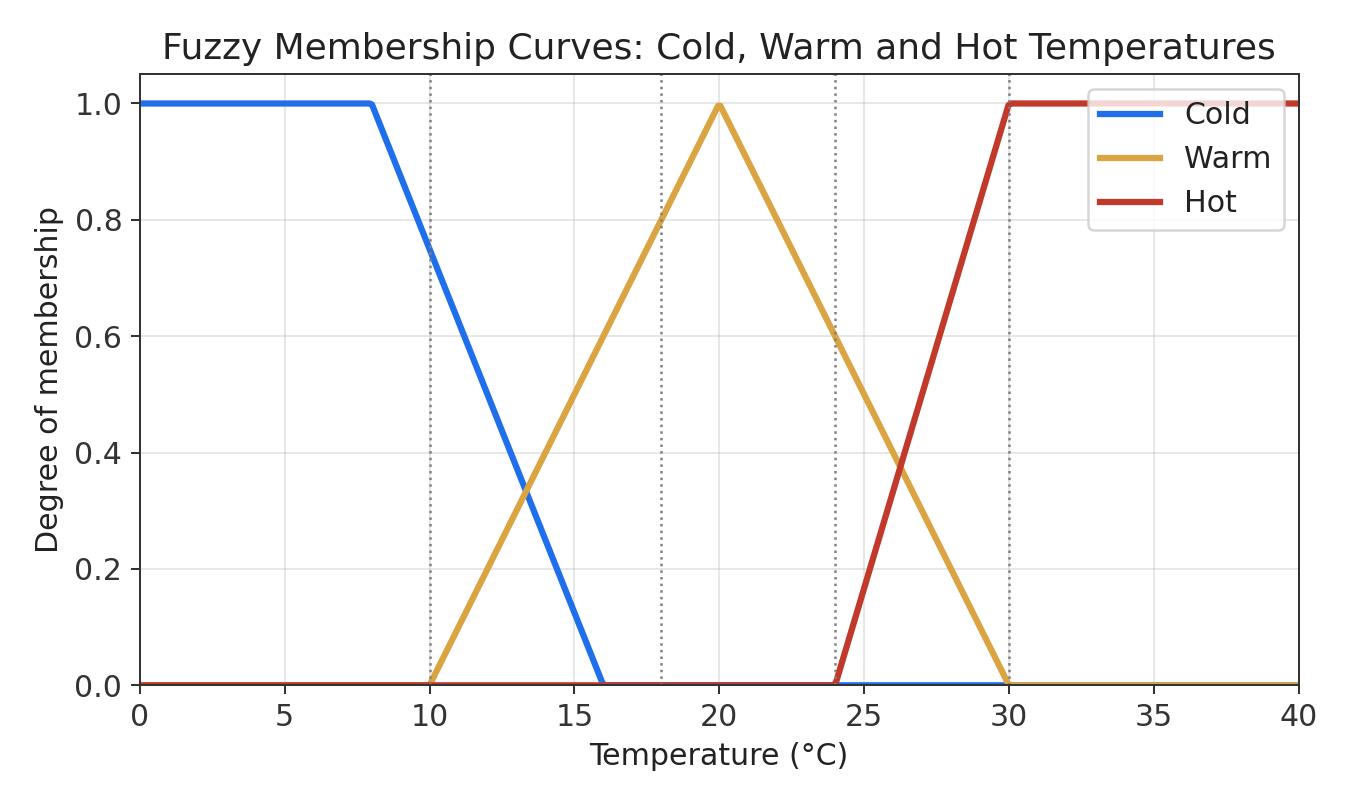
Notice how a single temperature can belong to more than one category at once. This is exactly what makes fuzzy functions different from classical, either/or logic.
Types of Fuzzy Functions Explained
Fuzzy functions come in several standard shapes, each suited to different kinds of real-world uncertainty.
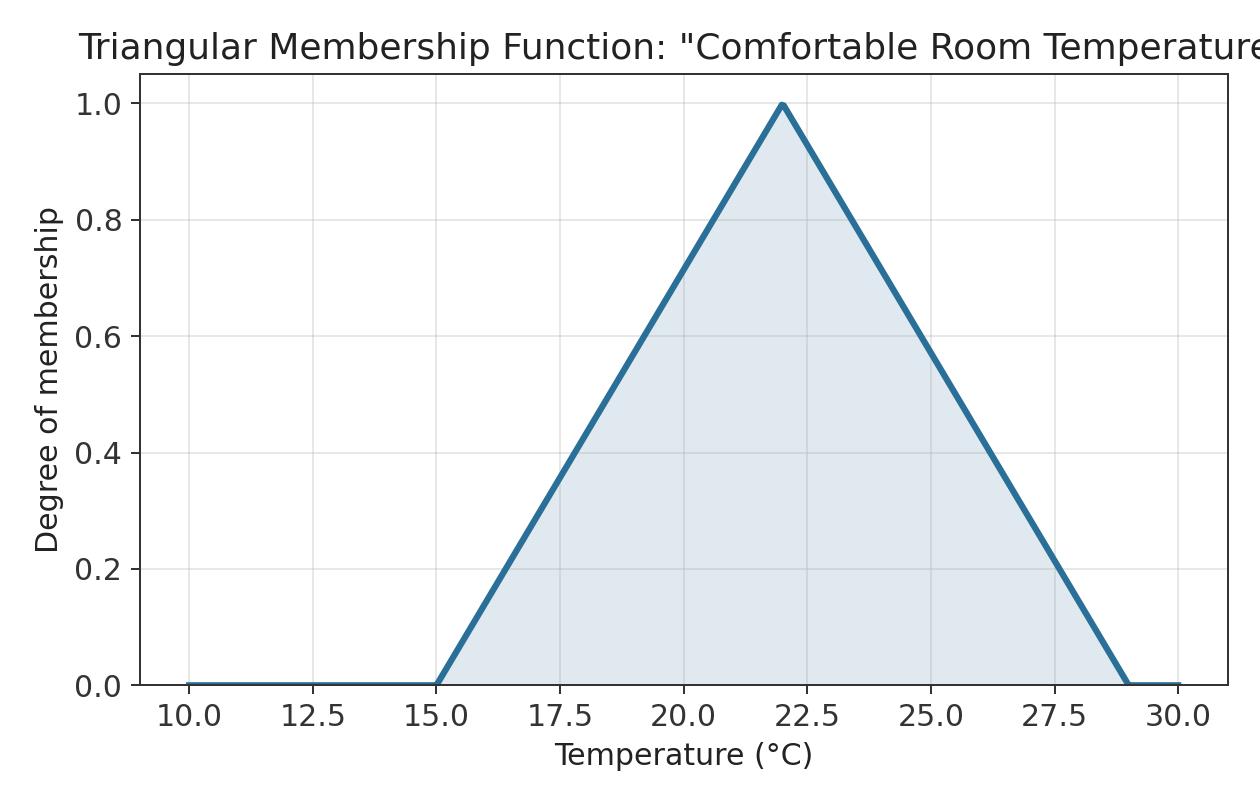
1. Triangular Membership Functions
The simplest and most common shape, rising linearly to a peak degree of 1, then falling back to 0. Useful for concepts with a clear "centre point", such as comfortable room temperature.
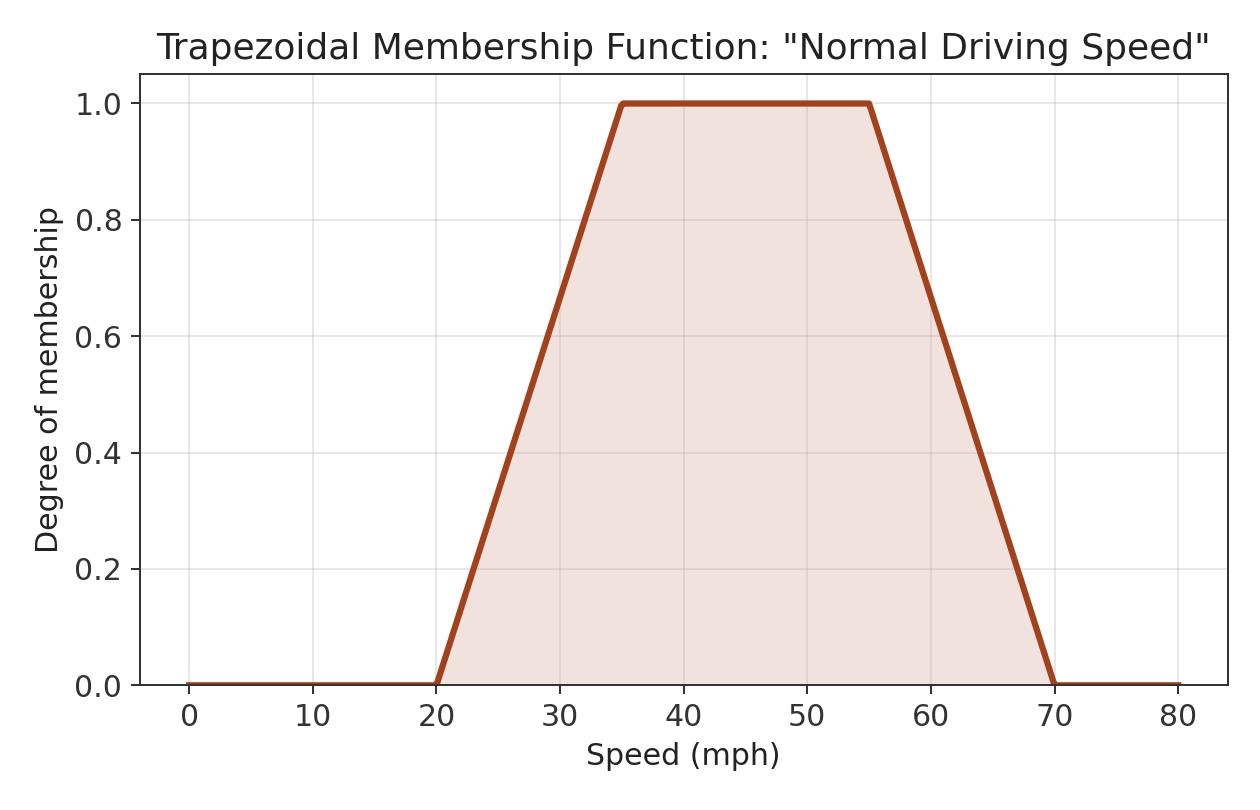
2. Trapezoidal Membership Functions
Similar to triangular functions, but with a flat plateau at the top where membership stays at 1 across a range of values. Well suited to concepts like normal driving speed, where there's a broad acceptable range rather than a single ideal point.
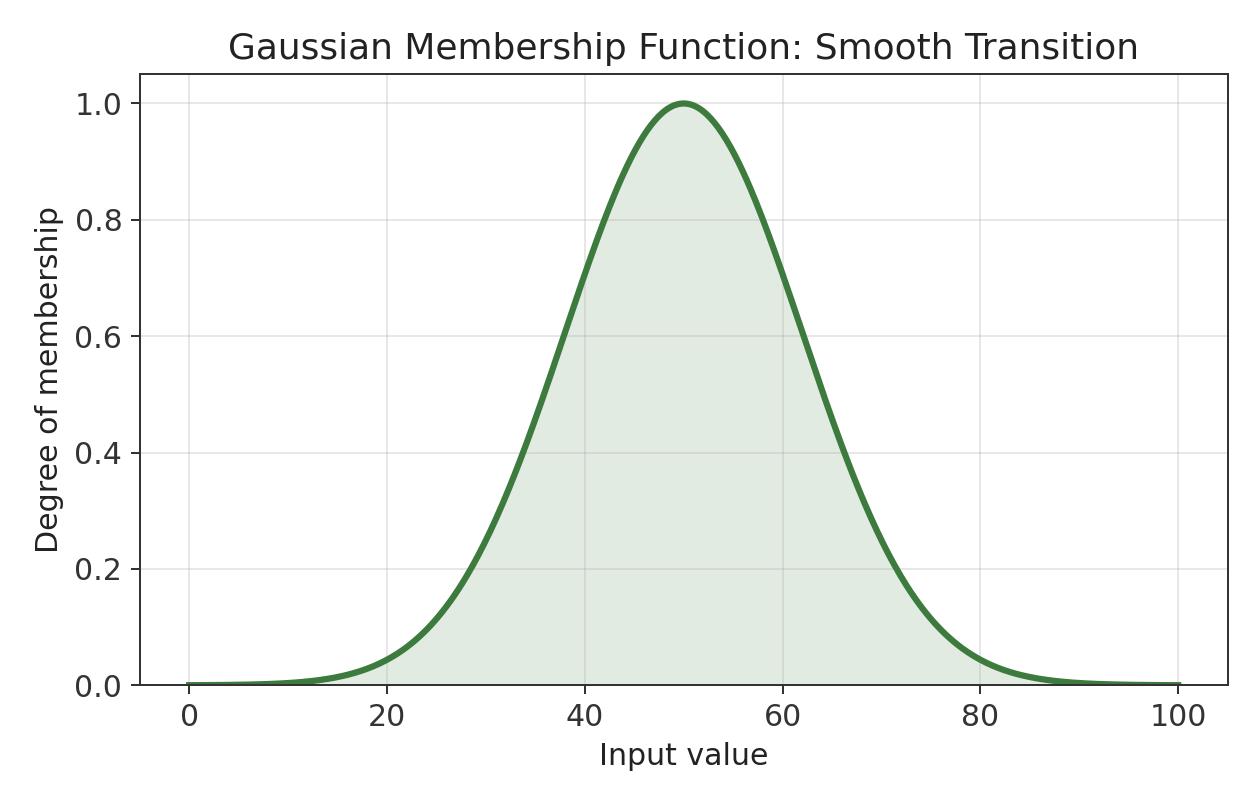
3. Gaussian Membership Functions
A smooth, bell-shaped curve based on the normal distribution. These are common in more advanced fuzzy systems, such as speech recognition, where gradual transitions produce more natural results.
Real-World Applications of Fuzzy Functions
Fuzzy functions show up in far more everyday technology than most people realise:
- Control systems, many household appliances such as washing machines, air conditioners, and refrigerators use fuzzy logic to operate more efficiently, adjusting fan speed or wash cycles by interpreting conditions as "slightly warm" or "very humid" rather than using rigid ON/OFF rules,
- Artificial intelligence, fuzzy functions help computers make decisions involving vague or incomplete data, including facial recognition, speech processing, and natural language understanding,
- Automotive industry, many modern cars use fuzzy logic controllers for automatic transmission systems and anti-lock braking, constantly adjusting their responses to changing road conditions and driving styles,
- Decision-making, businesses use fuzzy sets to model subjective judgements like "very likely", "somewhat satisfied", or "low risk", supporting better decisions around customer satisfaction and risk assessment.
How a Fuzzy Inference System Reaches a Decision
A fuzzy system does not stop at membership functions, it uses them to make an actual decision, through three steps:
- Fuzzification, a precise input (say, a room temperature of 24°C) is converted into degrees of membership across the relevant fuzzy sets, such as 0.7 "warm" and 0.3 "hot",
- Rule evaluation, fuzzy IF/THEN rules are applied, combining inputs using AND (the minimum of the two degrees) or OR (the maximum of the two degrees). For example: "IF temperature is warm AND humidity is high, THEN fan speed is medium",
- Defuzzification, the fuzzy result is converted back into a single, precise output the system can act on, most commonly using the centroid method, which finds the "centre of gravity" of the combined fuzzy output.
This three-step process is what allows a fuzzy air conditioner or washing machine to turn a vague description like "fairly humid" into a specific, usable setting.
Limitations of Fuzzy Functions
Fuzzy functions are a powerful tool, but not a perfect one. Rule bases can become large and difficult to manage once a system has many input variables, and choosing the shape and range of each membership function is often based on expert judgement or trial and error rather than a fixed formula. For this reason, fuzzy systems are usually combined with testing and refinement before being used in a live product.
Common Misunderstandings About Fuzzy Functions
A few misconceptions come up again and again when students first encounter fuzzy functions.
Misunderstanding 1: Fuzzy Means Random
Fuzzy functions are not about randomness or guesswork. Every membership value is calculated precisely using a defined function; the "fuzziness" refers to the concept being modelled, not the mathematics used to model it.
Misunderstanding 2: Membership Values Are Probabilities
A membership degree of 0.7 does not mean a 70% chance of something being true. It means the element is true to a degree of 0.7 at the same time as being true to some other degree elsewhere; probability and fuzzy membership follow different rules entirely.
Misunderstanding 3: Fuzzy Logic Is Less Precise Than Classical Logic
In practice, fuzzy logic is often more precise for real-world problems, since it can represent shades of truth that classical, binary logic simply cannot capture.
Where Fuzzy Functions Fit Into Education and Careers
Fuzzy functions are not a named topic on UK GCSE or A Level Maths or Computer Science syllabuses. That said, they do appear around formal study in a few places:
- As wider reading or enrichment within A Level Computer Science, alongside the artificial intelligence and algorithms strand of the course,
- As a natural extension topic for strong Further Maths students heading toward university-level maths or engineering,
- As a core, examined subject at undergraduate level in Computer Science, Electrical and Electronic Engineering, and Artificial Intelligence degrees.
The essentials to understand before going further:
- The basics of set theory and classical (crisp) logic,
- What a membership function is, and how it differs from a probability,
- The three main membership function shapes: triangular, trapezoidal, and Gaussian,
- What a fuzzy IF/THEN rule is, and how fuzzification and defuzzification connect input to output.
Conclusion
In a world full of uncertainty, fuzzy functions are an essential mathematical tool that helps us make smarter, more human-like decisions. They demonstrate that sometimes, the best solutions come from embracing ambiguity instead of ignoring it. Working with maths tutors on topics like this can help turn an unfamiliar, abstract idea into a genuinely useful problem-solving skill.
Get Tutor Help With Fuzzy Functions
Frequently Asked Questions About Fuzzy Functions
➕ What is the difference between a fuzzy function and a classical function? |
|---|
| A classical function maps each input to exactly one precise output, true or false, in or out. A fuzzy function instead maps an input to a degree of membership between 0 and 1, allowing an element to partially belong to more than one category at once. |
➕ Who introduced fuzzy logic and fuzzy functions? |
| Fuzzy sets and fuzzy logic were introduced by mathematician Lotfi Zadeh in the 1960s, opening a new branch of mathematics designed to handle vagueness and imprecise information in a structured way. |
➕ Are fuzzy functions used outside of mathematics classrooms? |
| Yes. They appear in household appliances, automotive control systems, artificial intelligence, and business decision-making, anywhere a system needs to reason with vague or overlapping categories rather than strict yes/no rules. |
➕ Is fuzzy logic the same as probability? |
| No. Probability describes the likelihood of an event happening, while fuzzy membership describes the degree to which something belongs to a category. The two follow different mathematical rules. |
Did you like this article? Share it now

Marjolin Jahja
(49)
English Language tutor in London specalised in offering online lessons classes adapted to the needs of each student. My classes are designed to help you reach your goals.Contact
Teaches Physics, Applied Mathematics, Maths, Algebra, Primary school, Secondary school, GCSE, University, Programming, Probability and Statistics, After-school tuition and SATs classes
Contact
Use our Smart Finder