 1Like
1Like

The Power of Euler’s Number e in Mathematics, Nature, and Real-Life Applications
Among the most important constants in mathematics stands the mysterious and powerful number e, also known as Euler's Number or Napier's Constant. Just like the well-known constant π (pi), Euler's number appears across a wide spectrum of mathematical disciplines and real-world phenomena. Its value is approximately 2.71828, and it is an irrational and transcendental number, meaning its decimal representation goes on forever without repeating, and it cannot be the root of any algebraic equation with rational coefficients.
Let's dive into this maths lesson to understand all you need to know about Euler's Number.
Content Table
What Is the Number e (Euler's Number)?
The number e is defined as the limit of the expression:
e = lim(n→∞) (1 + 1/n)ⁿ
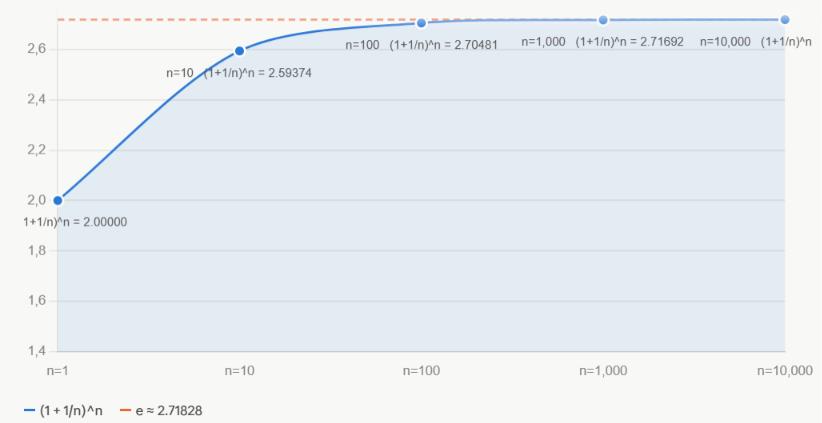
Seeing the limit in action
This might look abstract at first, but plugging in increasing values of n shows exactly how the result settles on Euler's number:
| n | (1 + 1/n)ⁿ |
|---|---|
| 1 | 2.00000 |
| 10 | 2.59374 |
| 100 | 2.70481 |
| 1,000 | 2.71692 |
| 10,000 | 2.71815 |
As n grows larger, the result gets closer and closer to e ≈ 2.71828, without ever quite reaching it exactly, hence why e is defined as a limit.
This formula arises from the study of compound interest, where the idea is: if you invest 1 unit of currency at 100% interest, and the interest is compounded more and more frequently, the amount of money approaches Euler's number as the compounding becomes continuous.
An equivalent definition: the infinite series
e can also be expressed as an infinite series:
e = 1 + 1/1! + 1/2! + 1/3! + ⋯
Here, the "!" symbol means factorial, which is the product of a whole number with every positive whole number below it. For example:
- 1! = 1
- 2! = 2 × 1 = 2
- 3! = 3 × 2 × 1 = 6
As more terms are added to the series, the sum gets closer and closer to the same value, 2.71828, that we reached with the limit formula above. In other words, the limit and the series are two different routes to the exact same constant.
This elegant series shows the deep connection between e and calculus, especially derivatives and integrals.
Why Is e So Important?
The number e is the base of natural logarithms, meaning:
ln(e) = 1 and ln(x) = logₑ(x)
But e is much more than a base for logarithms. It plays a critical role in:
- Exponential functions: f(x) = eˣ is the unique function whose derivative is itself.
- Growth and decay models: In nature and population modeling, exponential growth (e.g., bacteria reproduction) follows the form P(t) = P₀eʳᵗ, where r is the rate of growth.
- Radioactive decay: The half-life and decay of radioactive elements follow exponential patterns that involve e.
- Calculus: The function eˣ is fundamental in differential equations, integrals, and Taylor series expansions.
- Complex numbers: Euler's formula connects e with trigonometric functions and complex numbers: eⁱˣ = cos(x) + i sin(x). This is one of the most beautiful equations in mathematics and is used in physics, engineering, and signal processing.
A Worked Example
To see Euler's number in action, let's work through a real calculation step by step.
The scenario: You invest £1,000 at a continuous interest rate of 5% for one year.
Step 1: Identify the formula.
For continuous compounding, we use:
A = Peʳᵗ
Where:
- A = final amount
- P = principal (starting amount)
- r = interest rate (as a decimal)
- t = time (in years)
Step 2: Plug in the values.
- P = 1,000
- r = 0.05
- t = 1
So the calculation becomes:
A = 1000 × e^(0.05 × 1)
Step 3: Simplify the exponent.
A = 1000 × e^0.05
Step 4: Calculate e^0.05.
Using Euler's number (e ≈ 2.71828), we find:
e^0.05 ≈ 1.05127
Step 5: Multiply to find the final amount.
A = 1000 × 1.05127 ≈ £1,051.27
Step 6: Compare with simple annual compounding.
With standard annual compounding at 5%, the amount after one year would be exactly £1,050.00.
| Compounding type | Final amount |
|---|---|
| Simple annual compounding | £1,050.00 |
| Continuous compounding (using e) | £1,051.27 |
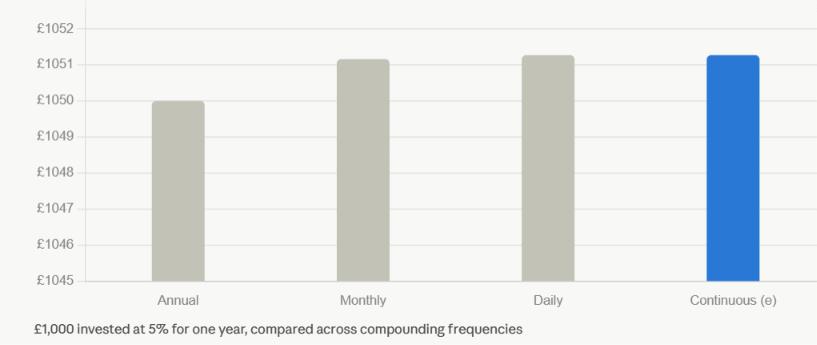
| The takeaway: continuous compounding always produces a slightly higher return than standard compounding, because interest is being calculated and added at every possible instant, rather than once a year. This small but consistent difference is the practical power of Euler's number at work in finance. |
Find the Perfect Maths Tutor for In-Person Private Lessons
Real-Life Applicationsof Euler's Number
- Finance: Continuous compounding of interest uses the formula A = Peʳᵗ, where A is the final amount, P is principal, r is interest rate, and t is time.
- Statistics: The normal distribution, also known as the bell curve, uses Euler's number in its probability density function.
- Computer science: The analysis of algorithms, particularly those involving recursion or randomness, often includes e.
- Biology: Models of population growth, disease spread, and biological decay all use exponential models built on e.
Common Mistakes to Avoid When Working with Euler's Number
Working with Euler's number is straightforward once the core ideas are clear, but a few classic mistakes trip students up again and again. Here are the two most frequent ones to watch out for.
1. Confusing e with π
Both e and π are irrational, transcendental constants, which leads many students to lump them together.
Common mistake: assuming e and π play the same role, or can be substituted for one another in formulas.
In reality, each constant belongs to a different mathematical context, and mixing them up leads to incorrect results.
Example:
| Constant | Context | Typical use |
|---|---|---|
| e | Growth and decay | Compound interest, population growth, radioactive decay |
| π | Circles and periodic motion | Circumference, area of a circle, trigonometric functions |
Even though both appear in advanced formulas, Euler's number governs exponential change, while π governs circular and periodic behaviour. They are never interchangeable.
2. Misapplying the derivative rule
Another frequent error happens in calculus, when students apply the standard power rule to eˣ instead of recognising its special property.
Wrong approach: treating eˣ like any other power, and differentiating it as x·eˣ⁻¹.
Correct rule: the derivative of eˣ is eˣ itself.
Example:
Function: f(x) = eˣ
Incorrect derivative: f'(x) = x·eˣ⁻¹ ❌
Correct derivative: f'(x) = eˣ ✅
This unique property, that eˣ is its own derivative, is one of the reasons Euler's number is so central to calculus.
Historical Background
Though the number is now commonly associated with Leonhard Euler, it was first discovered by John Napier, who introduced logarithms to simplify complex calculations. The symbol "e" was first used by Euler in the 18th century, and since then, Euler's number has become a pillar of modern mathematics.
The Power of Euleur's Number
The number e is not just an abstract mathematical curiosity. It is a fundamental constant that governs exponential behavior in nature, technology, and finance. From the exponential growth of populations to the decay of radioactive material, e is silently shaping the world around us. Understanding e is key to unlocking the secrets of growth, change, and the mathematics that power our universe.
Did you like this article? Share it now

Marjolin Jahja
(49)
English Language tutor in London specalised in offering online lessons classes adapted to the needs of each student. My classes are designed to help you reach your goals.Contact
Teaches Physics, Applied Mathematics, Maths, Algebra, Primary school, Secondary school, GCSE, University, Probability and Statistics, SATs, Programming and After-school tuition classes
Contact
Use our Smart Finder