 1Like
1Like


Demystifying Logarithms: Understanding Their Role and Real-Life Applications in Mathematics
Logarithms are among the most powerful and essential tools in mathematics. Despite appearing intimidating at first glance, they serve as indispensable instruments in various fields such as algebra, calculus, computer science, engineering, and even finance.
Whether you're dealing with exponential growth, solving equations, or compressing large-scale data, logarithms help simplify and reveal deep relationships between numbers. Let's dive into this online maths lesson to fully understand this concept!
Content Table
What Is a Logarithm?
At its core, a logarithm answers the question: to what exponent must a certain base be raised to produce a given number?
Mathematically, the logarithm is defined as:
If bˣ = y, then log_b(y) = x
Here:
- b is the base (must be positive and ≠ 1),
- x is the exponent, and
- y is the result.
For example, since 2³ = 8, we say log₂(8) = 3.
| Important restriction: logarithms are only defined for positive numbers. You cannot take the log of zero or a negative number, since no real exponent can produce those results from a positive base. |
Common Types of Logarithms
1. Common Logarithm (log₁₀)
-
- Uses base 10, and is written as log(x) without a visible base, since base 10 is assumed by default.
- Often used in scientific notation, engineering, and calculators, where quantities span many orders of magnitude.
- Example: log(1000) = 3, because 10³ = 1000. This is why the common logarithm is so useful for measuring things like pH levels in chemistry, where pH = −log₁₀[H⁺].
2. Natural Logarithm (ln(x) = log_e(x))
-
- Uses base e ≈ 2.71828, where e is Euler's number, a constant that arises naturally when modelling continuous growth or decay.
- Widely used in calculus, exponential growth/decay, and advanced mathematics, particularly wherever rates of change are involved.
- Example: ln(e³) = 3, since raising e to the power of 3 returns e³. Natural logarithms are essential in calculating continuous compound interest and in modelling radioactive decay.
3. Binary Logarithm (log₂(x))
-
- Base 2, crucial in computer science, especially in algorithms and data structures.
- Binary logarithms describe how many times a number can be halved before reaching 1, which is why they appear so often in computing contexts.
- Example: log₂(8) = 3, since 2³ = 8. This is the same reasoning used to calculate how many comparisons a binary search needs to find an item in a sorted list of 8 elements.
Laws of Logarithms
Logarithms follow several useful identities that simplify complex expressions:
1. Product Rule: log_b(xy) = log_b(x) + log_b(y)
This rule says that the log of a product splits into a sum of two separate logs. It works because logarithms are exponents in disguise, and when you multiply two numbers with the same base, you add their exponents. For example, log₂(4 × 8) = log₂(4) + log₂(8) = 2 + 3 = 5, which checks out, since 4 × 8 = 32 and log₂(32) = 5.
2. Quotient Rule: log_b(x/y) = log_b(x) − log_b(y)
This is the mirror image of the Product Rule: dividing two numbers becomes subtracting their logs. It follows the same logic, since dividing numbers with the same base means subtracting exponents. For example, log₂(32/4) = log₂(32) − log₂(4) = 5 − 2 = 3, which matches log₂(8) = 3.
3. Power Rule: log_b(xⁿ) = n · log_b(x)
When a number inside a log is raised to a power, that power can be pulled out and multiplied in front. This is especially useful for simplifying expressions with exponents, without expanding them fully first. For example, log₂(4³) = 3 · log₂(4) = 3 × 2 = 6, which matches log₂(64) = 6, since 4³ = 64.
4. Change of Base Rule: log_b(x) = log_k(x) / log_k(b), for any new base k
Most calculators only compute logs in base 10 (log) or base e (ln), so this rule lets you calculate a logarithm in any base by converting it into one of those two. For example, to calculate log₃(20) on a calculator, you'd compute log(20) / log(3) ≈ 1.301 / 0.477 ≈ 2.73.
These rules transform multiplication into addition, division into subtraction, and powers into multiplication, making calculations much easier, especially before the era of calculators.
Worked example: solve 5ˣ = 100 for x.
- Take the log of both sides: log(5ˣ) = log(100).
- Apply the Power Rule: x · log(5) = log(100).
- Divide both sides by log(5): x = log(100) / log(5).
- Calculate: x ≈ 2.86.
Find an Online GCSE Maths Tutor
Why Logarithms Matter
- Solving Exponential Equations:
Logarithms are essential for solving equations where the unknown appears in the exponent, such as 5ˣ = 100, which becomes x = log₅(100). - Complexity in Computer Science:
Many algorithms operate in O(log n) time, such as binary search. Understanding logarithms helps programmers write more efficient code. - Sound and Earthquakes:
The decibel scale for sound intensity and the Richter scale for earthquakes are logarithmic, meaning each step represents a tenfold increase. - Finance and Economics:
Logarithms are used in modeling compound interest, exponential growth of investments, and measuring elasticity in economics. - Data Compression and Entropy:
Information theory uses logarithms to measure information content and entropy, vital for file compression and transmission.
Logarithms in UK Exams
Logarithms appear across the UK maths curriculum, most notably at A-Level, where they're essential for solving exponential equations and studying calculus. They also form part of some GCSE Higher Tier specifications, particularly around exponential graphs and growth/decay contexts, though the depth of coverage varies by exam board. If this topic feels tricky, a maths tutor can help make sense of it step by step.
Essential aspects of logarithms for GCSE and A-Level:
- Understanding the relationship between exponents and logarithms, and being able to convert between the two forms,
- Knowing the laws of logarithms (Product, Quotient, Power, and Change of Base) and applying them to simplify expressions,
- Being able to solve exponential equations using logarithms, including equations with unknown exponents,
- Recognising and working with natural logarithms (ln) in A-Level calculus, particularly differentiation and integration involving e,
- Understanding logarithmic and exponential graphs, including their key features such as asymptotes and intercepts,
- Knowing the domain restrictions of logarithms, since exam questions often test whether students recognise invalid inputs,
- Applying the change of base formula to evaluate logarithms on a calculator when the base isn't 10 or e.
Logarithmic vs. Exponential Growth
Logarithmic growth is the inverse of exponential growth:
- Exponential functions grow rapidly and are used in modeling populations, pandemics, and investments.
- Logarithmic functions grow slowly and are used when phenomena decelerate over time, like learning curves or cooling processes.
Logarithmic Graphs
Graphs of logarithmic functions are distinctive: they pass through (1, 0), increase slowly, and never touch the y-axis (they have a vertical asymptote). This behavior makes them ideal for scaling data over large ranges, logarithmic scales compress large values into manageable intervals.
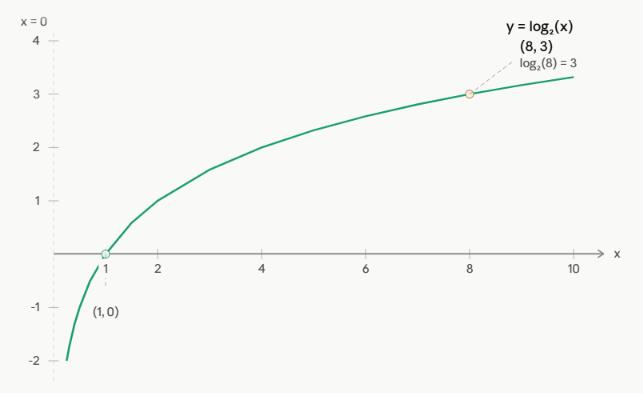
Key features of a logarithmic graph:
- The curve always passes through (1, 0), since log_b(1) = 0 for any valid base b,
- There is a vertical asymptote at x = 0, meaning the graph approaches but never touches the y-axis, reflecting the fact that logarithms are undefined for zero or negative numbers,
- The curve rises slowly and continuously as x increases, never levelling off completely, but growing at a decreasing rate,
- A larger base produces a flatter curve, since it takes larger increases in x to produce the same rise in y,
- The graph is the mirror image (reflection) of its corresponding exponential graph across the line y = x, since logarithmic and exponential functions are inverses of one another.
Worked example:
For the graph of y = log₂(x), the point (8, 3) lies on the curve because 2³ = 8. This shows how the graph translates the abstract rule "2 to the power of 3 equals 8" into a visual point that can be read directly off the curve, which is especially useful for estimating logarithm values without a calculator.
Most Common Mistakes to Avoid When Working with Logarithms
- Assuming log(x + y) = log(x) + log(y): this is incorrect. The Product Rule only applies to log(xy), not to the log of a sum.
- Forgetting the domain restriction: trying to evaluate the log of zero or a negative number is undefined and will lead to an invalid answer in exam questions.
- Mixing up the Quotient Rule direction: log_b(x/y) equals log_b(x) − log_b(y), not the other way around.
- Confusing natural and common logarithms: ln(x) uses base e, while log(x) without a subscript is assumed to be base 10, mixing these up leads to calculation errors.
- Misapplying the Power Rule: log_b(xⁿ) = n · log_b(x) only works when the entire argument is raised to the power, not just part of an expression.
- Forgetting to check the base when using a calculator: most calculators only compute log (base 10) and ln (base e) directly, so the Change of Base Rule is needed for other bases.
Conclusion
Logarithms are more than just abstract concepts, they're practical tools that help us make sense of exponential relationships and patterns in the real world. Whether you're solving equations, analyzing algorithms, or understanding nature's laws, logarithms provide clarity, simplicity, and power. If you'd like extra support with this topic, working with a maths tutor can help build confidence step by step.
Frequently Asked Questions About Logarithms
➕ What is a logarithm in simple terms? |
| A logarithm tells you what exponent a base needs to produce a given number. For example, log₂(8) = 3 because 2³ = 8. |
➕ Why can't you take the log of a negative number? |
| No real exponent applied to a positive base can produce a negative result, so logarithms of negative numbers or zero are undefined in real numbers. |
➕ Where are logarithms used at GCSE and A-Level? |
| They appear in A-Level Maths, particularly in exponential equations, calculus, and some further maths modules, and in some GCSE Higher Tier content. |
Did you like this article? Share it now

Marjolin Jahja
(49)
English Language tutor in London specalised in offering online lessons classes adapted to the needs of each student. My classes are designed to help you reach your goals.Contact
Teaches Physics, Applied Mathematics, Maths, Algebra, Primary school, Secondary school, GCSE, University, Programming, Probability and Statistics, After-school tuition and SATs classes
Contact
Use our Smart Finder