
- Blog
- How to become a tutor?
How to become a tutor

 22Like
Key Things to Know Before You Become a Tutor:📋 No formal qualifications are required to become a private tutor in the UK. What matters most is solid subject knowledge, patience, and a genuine interest in helping others learn. 📍 Decide your lesson format early: in-person tutoring requires you to factor in travel time and costs, while online tutoring opens your student base to the whole of the UK. 📣 Don't rely on one channel to find students. Combine word of mouth, a tutoring platform profile, and social media to maximise your visibility from the start. 📅 Treat your tutoring like a business from day one. Keep a clear schedule, track your income and expenses, stay organised, and track your students' needs and progress closely. |
Congratulations! If you are reading this, it means that you have decided to become a tutor. Or perhaps you are already a private tutor, but you still have some unanswered questions that need resolving. Either way, teaching private classes is no easy feat.
As a tutor, you will have a huge impact on your students’ education- a responsibility that should not be taken lightly. A tutor’s role goes far beyond that of the classroom; a good tutor moulds their students and prepares them for the future.
Whether you're a student looking to earn on the side, a qualified teacher wanting more flexibility, or a professional keen to share your expertise, this guide covers everything you need to know to become a private tutor with confidence.
Content Table
- Why become a private tutor?
- How to get started
- How to get students
- Do you need to pay tax as a tutor?
- What qualities does a good tutor have?
- How to stay organised as a tutor
- Learn how to create lesson plans
- Learn how to motivate students
- Ready to become a tutor?
- Most Frequently Asked Questions About Becoming a Tutor
Why become a private tutor?
Private tutoring is one of the most accessible and rewarding ways to earn an income from your knowledge. You don't need to be a qualified teacher, you just need solid subject knowledge, patience, and a genuine interest in helping others learn.
Here's why becoming a tutor is worth considering:
- Flexible hours: You set your own schedule, whether that's evenings, weekends, or full-time, during holidays, etc.,
- No commissions: You are your own boss. By starting your tutoring activity you get decide how much you can charge per lesson and don’t have to pay any commission to anyone. And the same goes if ou decide to teach online; on FindTutors, you keep 100% of what you earn,
- Freedom on rates: You decide what to charge based on your experience and subject. The choices are yours to make,
- Low barrier to entry: there are no major upfront costs because creating a profile online to find students and printing out simple A4 adverts are either free or cheap. You can also get started simply by asking if any students or families know anyone that may be interested in private tutoring (at schools, in your neighboorhood, in your social media, etc.),
- Genuine impact: One-to-one teaching creates real, measurable progress for your students. Tutoring is a noble job that leads to real positive impact in people’s lives.
How to get started?
1. First things first; is tutoring for you ?
A passion for teaching is essential when it comes to teaching private classes. The first thing to bear in mind is whether you have the patience and motivation to teach someone, as not everyone is cut out to be a tutor.
The next thing to consider is whether you want to be a full-time tutor or whether it is something that you will do temporarily or part-time. Tutoring part-time can be a good way to supplement your main income, disconnect from your day-to-day life and can give you more time to focus on each individual student.

2. Choose your lesson format
One of the first decisions you'll need to make before becoming a tutor is how you want to teach: in person, online, or both. There's no right or wrong answer here, but it's worth thinking it through carefully, as it will shape how you find students, how you organise your time, and how much you earn.
Teaching in person
In-person tutoring means meeting your student at an agreed location, typically their home, your home, or a neutral space such as a library.
Before committing to this format, there are a few practical things to consider:
- Travel time and cost: If you go to the student's home, the journey comes out of your own time and pocket. Factor this into your rate or set a maximum travel radius you're comfortable with,
- Your travel radius: Decide in advance how far you're willing to travel. Many tutors set a limit of 5 to 15 miles. Being clear about this upfront avoids wasted time on enquiries that don't work geographically,
- Location logistics: If students come to you, make sure you have a suitable, quiet space to teach. If you go to them, you'll need to be comfortable working in different environments,
- Equipment: For certain subjects, you may need to bring physical materials such as worksheets, textbooks, or instruments.
Teaching online
Online tutoring takes place via video call tools such as Zoom, Google Meet, or Skype. It removes the travel question entirely and opens your potential student base beyond your local area to anywhere in the UK, or even internationally.
Things to consider for online teaching:
- Tech setup: You'll need a reliable internet connection, a decent webcam, and a microphone. A digital whiteboard tool can also be useful for subjects like maths or science,
- Screen sharing and resources: Most video call platforms allow you to share your screen and documents, which works well for written subjects or language learning,
- Student focus: Keeping younger students engaged online can require more effort and creative techniques than in-person sessions.
Which format is right for you?
|
In person |
Online |
|
|
Travel required |
Yes, can add time and cost |
No |
|
Student reach |
Local area only |
UK-wide or beyond |
|
Setup cost |
Low |
Low to moderate (tech) |
|
Subject flexibility |
High |
High for most subjects |
|
Younger students |
Generally easier to manage |
Requires more engagement effort |
|
Scheduling flexibility |
Lower (commute time adds up) |
Higher |
Many tutors choose to offer both formats to maximise the number of enquiries they receive. You can always start with one and add the other once you're more established. On FindTutors, you can specify your preferred format directly on your profile so students know what to expect before they contact you.

3. Choose your subject(s) : what’s in demand?
Before you become a tutor an start tutoring, you’ll need to choose a subject (or multiple ones if that’s your case).
As you make your decision, you should know that teaching a subject that is less in demand has its advantages. Less competition means that the few students that want to find a tutor specialising in the subject will most likely contact you.

However, for those who wish to teach a popular subject, these tutors are the most in demand:
- GCSE and A Level tutors: Tuition is undeniably popular amongst secondary school students, especially when it comes to GCSEs and A Levels. Whilst there are no official requirements, to become a GCSE tutor or to become an A Levels tutor you should have ideally studied the subjects you wish to teach at this level.
- Physics and Chemistry tutors: Whilst science in general is itself a popular subject among students, physics and chemistry are among the most searched for branches of science as they are often the most complicated subjects for school children. This is why GCSE and A Level physics and chemistry tutors are high in demand.
- English tutors: English as a second or foreign language is one of the most popular subjects and not just in the UK. Many students of all ages are looking to improve their English and in many cases they are looking to achieve a certain qualification like the First Certificate in English or the Certificate in Advanced English. If you are not a native speaker, it is recommended that you have at least a C1 level to teach English as a foregin language.
- French and Spanish tutors: French and Spanish are extremely popular foreign languages amongst students. It is recommended that these tutors are either native speakers or a C1 level in order to start tutoring Spanish and French.
- Maths tutors: School subjects and maths in particular are high in demand. From primary school to university level, there are students of all levels needing maths tutors online.
4. What should you charge?
How much should you charge for private lessons? Deciding on how to price your lessons is probably one of the least exciting and most difficult parts of becoming a tutor. For many young tutors, this is their first job and even for the more experienced tutors, it is hard to know what the going rate is. After all, the tutoring market is diverse, and rates vary depending on subject, level, experience, and location.
Here's what lessons typically cost for students on FindTutors, to give you a starting point:
|
Subject |
Typical hourly rate |
|
Maths |
£12–£21 / hour |
|
French |
£18–£20 / hour |
|
GCSE preparation |
£18–£22 / hour |
And here's what tutors can realistically earn depending on how many hours they teach per week:
|
Hours per week |
Estimated monthly earnings |
|
10 hours/week |
~£530/month |
|
20 hours/week |
~£1,060/month |
|
30 hours/week |
~£1,590/month |
|
40 hours/week |
~£2,120/month |
Start Earning Extra Income as a Tutor
|
Disclaimer: These figures are based on current active tutor rates for in-demand subjects. Actual earnings may vary by subject, location, and experience. |
Here are other factors to keep in mind in order to set your rates:
- Research the prices in your area. You can do this by going to our website and searching for your subject as if you were a student.
- Do some field work and work out the average rate for classes in your subject or have a look at our pricing page.
- Make sure you include the cost of preparation and travelling to the location of the classes.
- Do you have qualifications or experience? If you are a qualified tutor or have plenty of experience teaching private classes, you can charge a higher price than your unqualified or inexperienced counterparts.
- Offer something unique if you wish to charge more for your classes. This could come in many forms but, for example, if you teach a rare or complicated subject that requires a lot of knowledge, you can charge more.
- Offer results and a guarantee of success. Tutors with a high success rate and good reviews can price their classes higher.
5. Advertise your tutoring services
Now it’s time to advertise yourself as a private tutor ! There are many ways you can do this:
- Share your services with family, friends, and colleagues. Word of mouth remains one of the most effective ways to get your first students,
- Announce your services or a short introduction on your personal social media accounts,
- Put up a printed poster in local libraries, community centres, or schools (with permission),
- Post a free tutor ad on FindTutors to reach students actively searching for help in your subject,
- Browse student ads on the FindTutors platform. There, you’ll see students post their own requests, and you can reach out directly if their needs match with what you have to offer.

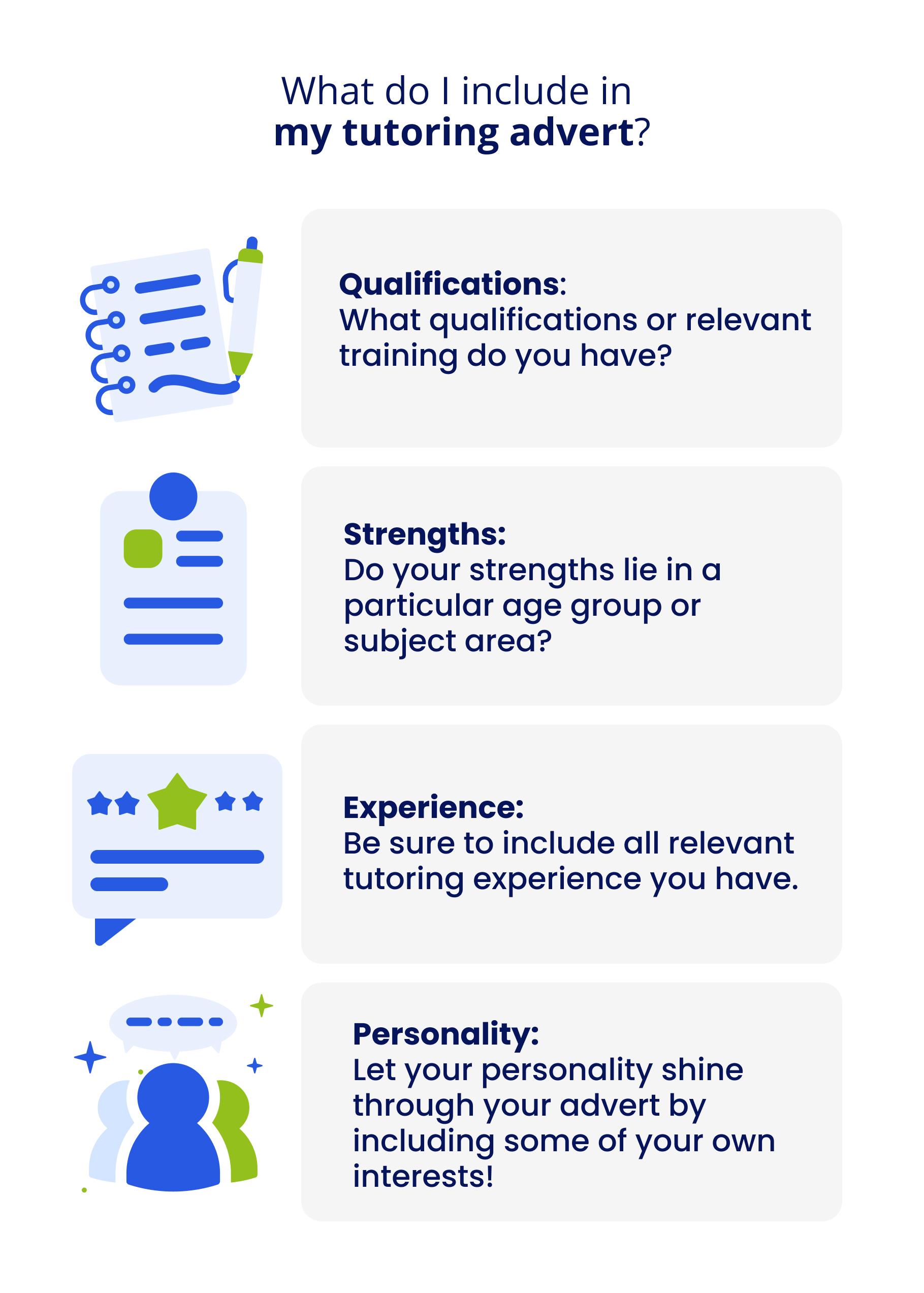
However ! Before announcing your tutoring services you should consider and determine the following:
- Qualifications. What qualifications do you have? Do you have training in the subject that you want to teach? Whilst qualifications are not always necessary, teachers who are more qualified can naturally charge more for their time.
- Strengths and weaknesses. In addition to your qualifications, you should also take your strengths into account. What were you good at in school? Similarly, try and reflect honestly on your weaknesses. What did you struggle with? Even if you found something difficult, you could be of great help to students who are at a lower level. If you succeeded, you can help them succeed too.
- Experience. Professional experience is not only limited to tutoring. Depending on what you wish to teach, students may be interested in knowing more about you. For example, a guitar teacher may want to include what bands they have played in and what type of music they are experienced in. A French teacher on the other hand, may want to highlight the fact that they have lived in a French-speaking country. Similarly to qualified tutors, an experienced tutor can also charge more for their time.
- Personality. It is essential that you are able to accurately evaluate yourself. Are you a patient person? Do you have good communication skills? If you have never taught before, it can be hard to imagine what you will be like as a tutor. However, having the right personality is a key factor when it comes to becoming a tutor, so it is important to spend some time identifying whether it suits your personality.
Become an English Language Tutor
What really counts here is your intuition and knowing what you are ready for but, for example, if you are a university student, logically you should be able to give classes to secondary school students. Similarly, a master’s student will be able to help undergraduate students.
And if you don’t know which means of advertising to start with, simply try using an online tutoring platform like FindTutors. There you can advertise your private classes online and start receiving requests from potential students. You can also look up other tutors teaching the same subject as you to get an idea of the competition and what the going rate is. This is easiest and mor edirect option out there to become a tutor.
How to get students?
Once everything is prepared, all you need to do is start receiving students for your private classes. The majority of tutors start tutoring because they already have one or two students, however if this is not the case for you, do not worry. Online tutoring platforms can help you start from scratch.
Spread the word
Although nowadays having social media is essential for private tutors, word of mouth is still the most effective way to get students. That is why it is important to tell everyone you know that you give private tuition, you never know who may need a private tutor.
Create an advert on a tutoring platform
Another easy way to do this is to create an advert and share it. Make sure you create a good advert with a detailed description and a photo that will reassure your potential students. Think about when you shop online, what things do you take into account before you buy something?
Build your reviews
Speaking of shopping online, this is also why it is important that you ask your students to evaluate you. If they are not registered as a student on FindTutors yet, ask them to register and leave a comment under your profile. Increasingly, people tend to go straight to the reviews before making a decision.
Stand out
If you’re tutoring online, try and separate yourself from other tutors that teach the same subject as you. Read the adverts of other tutors and try to make yours stand out. Ask yourself:
- What can I offer students that other tutors cannot?,
- Do my profile photo and description give a clear, trustworthy first impression?,
- Am I highlighting the right experience and qualifications for the students I want to attract?,
- Is my rate competitive for my level and subject area?
Another easy way to stand out from other tutors online on a tutoring platform is to write a blog post or create professional social media accounts. If students like how you write, like the knowledge you shared and, more importantly, if they feel your blog has helped them solve a problem they had, then they are more likely to ask for a lesson with you.
Do you need to pay tax as a tutor?
One of the most frequently asked questions amongst tutors who have just started is whether they need to declare their income. The answer is, yes.
If you earn more than £1,000 from tutoring in a tax year (April to April), you must register as self-employed and submit a Self Assessment tax return to HMRC.
The key things to keep in mind:
- Trading Allowance: The first £1,000 of income is tax-free under the Trading Allowance, no need to declare anything below this threshold,
- Self Assessment: Above £1,000, register with HMRC and submit a return by 31 January each year,
- National Insurance: You may also need to pay Class 2 or Class 4 National Insurance contributions depending on your profit level,
HMRC offers free resources and guidance for self-employed workers in case you have any more doubts about this procedure.
What qualities does a good tutor have?
All jobs require a certain skill set. However, very rarely will you find someone that has all of the desired skills for their profession. With this in mind, we have listed below the top 10 qualities of a good tutor, though this does not mean that you have to possess them all.
- Responsible: A tutor should be responsible, focusing on helping their students achieve their goals by carefully planning and organising each lesson.
- Flexible: A good tutor will adapt their teaching style and methods according to each student’s needs and be able to explain concepts in different ways. Being flexible is also important for tutors as they should update their teaching methods as their old ones become obsolete.
- Good communicator: Good communication skills are an essential part of tutoring, a tutor’s main objective is to be able to break down and explain complex concepts to their students.
- Observant: Listen to your student, give them space to express themselves and help them by identifying things that they struggle with.
- Patient: Patience is one of the most important qualities of a good tutor. Being knowledgeable about something does not necessarily mean that you will be good at teaching it. A tutor needs to be able to refrain from becoming annoyed if a student does not understand a concept that has been explained repeatedly.
- Inspiring: Students who are inspired by what they are learning will study even when they are not in class. It is easier to inspire students through private lessons since you can tailor each lesson to their needs, introducing topics and activities that you think will interest them.
- Innovative: A good tutor should be open to new teaching methods, you never know what could transform the way you teach and make it easier. Being innovative is also essential in order to keep up with the competition.
- Diplomatic: Although this is more important for school teachers or tutors who teach groups, be prepared to mediate disputes between students or students and their parents.
- Empathetic: This is one of the main qualities a tutor should have. As tutors and their students spend lesson time one on one, it is natural for them to establish a bond. It’s also essential for tutors to understand and listen to their students so that they can successfully help them.
- Charismatic: Whether tutoring is successful or not largely depends on the tutor having a good relationship with their student. A charismatic tutor will easily captivate their students and make lessons more interesting for them.
How to stay organised as a tutor?
Being a good tutor isn't just about what happens during the lesson. How you manage your time, your students, and your admin outside of teaching hours has a direct impact on your reputation and your income.
Here are the key areas to get on top of from the start:
Keep a clear schedule
Whether you teach one student or ten, a reliable calendar is essential. Use a digital calendar such as Google Calendar or a simple scheduling tool to log all your lessons, block out your available slots, and set reminders before each session. This helps you avoid double-bookings, last-minute cancellations, and missed appointments, which can quickly damage your reviews and your relationship with students.
Track your income and expenses
As a self-employed tutor, you are responsible for your own finances. Get into the habit of recording every lesson you give, what you charged, and whether you've been paid. Keep a simple spreadsheet or use a free tool like Wave or QuickBooks to log your income. Also track any expenses such as travel costs, printed materials, or equipment, as these may be deductible when you file your Self Assessment tax return.
Communicate clearly and promptly
Responding to student enquiries quickly makes a strong first impression. Once you're working with a student, set clear expectations from the start:
- Agree on lesson times and how much notice is needed to reschedule or cancel,
- Confirm lesson details in writing, even if just via message,
- Follow up after lessons with a brief note on what was covered and what to prepare next.
Keep notes on each student
Every student is different. Keeping short notes after each session, covering what was covered, what the student struggled with, and what to focus on next, means you walk into every lesson prepared. It also shows students and parents that you're invested in their progress.
Set boundaries early
Decide your working hours and stick to them. Let students and parents know when you're available to respond to messages. This protects your time and sets a professional tone from the start.

Learn how to create lesson plans
Whilst knowledge is a key part of a tutor’s success, it’s not the only influencing factor. Even if you are good at improvisation, lesson planning is essential. If you do not plan ahead you can end up losing an entire class due to interruptions or other unforeseen events.
Before lesson planning, set goals with your students. Discuss your student’s goals ahead of time so that you can tailor your lesson plans accordingly.
Prepare your lessons:
- Outline the topic.
- Brainstorm your ideas
- Prepare questions to check your student’s comprehension
- Create worksheets related to the topic.
- Prepare examples to reinforce knowledge.
- Prepare photos and diagrams to provide visual support.
Here are some lesson planning tips:
- Prepare questions.
- Plan interruptions or breaks to make the class enjoyable.
- Use humour.
- Calculate the time of each activity.
- Prepare the classroom environment.
- Prepare the teaching material.
Learn how to motivate students
Once you start teaching, the most important thing is to maintain a good relationship with your student. The best results come from a student who is motivated and interested in the subject.
Making sure your students are passionate about the subject is as important as it is difficult. For tutors who teach adult learners, this tends to be easier as adults often have chosen to study or relearn something out of personal interest. For tutors who teach children, however, this task can be a challenge.
Here are some tips to keep your students motivated:
- Spark an interest: The best way to do this is to relate the topic to the student’s interests and hobbies.
- Create a bond: The advantage of private tuition is that, thanks to the one on one nature of the lessons, there is more opportunity for the student and tutor to become friends and share a bond.
- Use engaging techniques: Another benefit of teaching private lessons is that you are not as restricted by curriculums and textbooks. Try out new and fun teaching methods that will make your classes more dynamic.
- Give praise: Whilst it’s important to be honest and give feedback to your students when they make mistakes, do not forget to reward your students and give them positive feedback.
Ready to become a tutor?
Becoming a private tutor is one of the most rewarding ways to earn from what you know. You've now got everything you need to get started: choosing your format and subject, setting your rates, advertising your services, understanding your tax obligations, and building strong relationships with your students. The rest comes with experience. Create your free profile on FindTutors today and take your first step towards becoming a tutor on your own terms.
Are you ready? Join FindTutors and start tutoring today!
Most Frequently Asked Questions About Becoming a Tutor
➕ Do I need qualifications to become a tutor? |
|
No formal qualifications are required to become a private tutor in the UK. What matters most is solid subject knowledge and the ability to explain concepts clearly. That said, having relevant qualifications or experience can help you charge higher rates and attract more students. |
➕ How much can I earn as a tutor? |
|
Earnings vary depending on your subject, level, experience, and how many hours you teach. On FindTutors, tutors teaching 10 hours a week typically earn around £530/month, rising to approximately £2,120/month at 40 hours a week. |
➕ Can I become a tutor with no experience? |
|
Yes. Many tutors start with no prior teaching experience. If you have strong knowledge of a subject and a patient, clear communication style, you already have the foundations. You can build experience gradually, starting with students at a lower level than your own. |
➕ How do I get my first students as a new tutor? |
|
The most effective starting points are word of mouth and creating a free profile on FindTutors. Tell people in your network, post a free tutor ad, and consider browsing the student ads section where learners post their own requests. |