 1Like
1Like


- Blog
- Statistics
- UK Home Schooling Statistics 2026
UK Home Schooling Statistics 2026: What the Data Really Shows

📌 6 key statistics on UK home schooling:🔵 126,000 children were in elective home education in England on census day, autumn 2025, up 13% on the year before. 🔵 Home-educated children make up roughly the same share of the school population in England (~1.6%) and Wales (~1.5%), despite England's raw total being over 17 times larger. 🔵 Mental health is the single most commonly cited reason for home education in England (16%), ahead of philosophical or preferential choice (12%). 🔵 Almost 3 in 10 cases are recorded as "unknown to the local authority" or with no reason given at all, the largest single category of all. 🔵 A recent UK/Ireland study found school-educated children scored higher on psychosocial difficulty measures than home-educated children, the opposite of what's commonly assumed. 🔵 The cost of home education ranges from as little as £205 a year to well over £7,000, depending entirely on how much tutoring and structured support a family chooses to use. |
More families across the UK are choosing to teach their children at home than ever before, and the home schooling statistics behind that shift are more interesting than the headline numbers suggest. This piece pulls together the latest UK home schooling statistics for England, Wales, Scotland and Northern Ireland, alongside research on wellbeing, demographics, and the real cost of going it alone.
The UK isn't alone in this either, home education has been rising in very different ways across other countries too, shaped by local laws, culture, and access to schooling. Whatever your reason for reading, whether you're a parent weighing up the decision or simply curious about the trend, you'll find somewhere to start browsing in-person private tutors if extra support is part of your plan.
Content Table
- What is home schooling?
- How many children are home educated across the UK?
- The year-on-year trend across the UK
- Why are more families choosing home education?
- Who is being home educated? England and Wales in focus
- What does the research say about wellbeing and home education?
- What does home education actually cost?
- Homeschooling in the UK is only as cheap as you choose to make it
- What this means for families considering home education
- What the UK home schooling statistics really add up to
- Frequently asked questions about home schooling statistics in the UK
- Sources
📋 How this article was put togetherThis piece draws on several different types of source, and each one is labelled as it appears throughout the article, so you always know how solid a figure is. Official government statistics (the Department for Education, Welsh Government, National Audit Office, Child Poverty Action Group) form the backbone wherever they exist, alongside peer-reviewed academic research where relevant. Where no single official UK body publishes a national figure, notably for Scotland and Northern Ireland, we've used the best available council-reported or press/FOI-compiled data instead, and flagged it clearly as non-official rather than presenting it with the same confidence as a government census. For tutoring and cost figures, we've used first-party data from FindTutors' own UK Private Tuition Price Report 2026, and published exam centre fee schedules for exam-related costs. Where no reliable source exists at all, mainly for general home education materials and resources, we built our own indicative estimates by cross-referencing publicly available UK home education cost guides, clearly marked as FindTutors' own calculations rather than verified statistics. All figures reflect the most recent releases available as of September 2026. Where a statistic has since been updated or superseded, the source link will always point you to the latest version. |
What is home schooling?
"Home schooling" and "home education" are used interchangeably in the UK, though the official term is elective home education, or EHE. It simply means a parent chooses to educate their child at home instead of enrolling them in school full time.
The legal basis is Section 7 of the Education Act 1996, which puts the duty on parents, not schools, to ensure their child receives "efficient, full-time education suitable to their age, ability and aptitude, and to any special educational needs they may have," either at school "or otherwise." That "or otherwise" is the single clause that makes home education legal across the whole UK.
None of the key terms, efficient, full-time, or suitable, are actually defined in the Act. Case law (Harrison v Stephenson, 1981) settled that "suitable" means an education that lets a child reach their potential and prepares them for life in society, not that it has to resemble school. There's no requirement to follow the National Curriculum, and no requirement to match school hours or term dates.
Formal schooling didn't become compulsory in England and Wales until the Elementary Education Act 1880, which required attendance for children aged 5 to 10, only 146 years ago. Before that, education existed but was voluntary and mostly fee-based. The leaving age has been raised repeatedly since: to 11 in 1893, 12 in 1899, 14 in 1918, 15 in 1944, and 16 in 1972. Today, young people in England must stay in education or training until 18, though not necessarily at school. In other words, compulsory schooling as most people picture it today is a surprisingly recent invention, and one that's changed shape roughly once a generation since it began. Home-based education actually predates all of this by a long way, going back to well before the state had any role in children's learning at all.
Legally, home education is a recognised choice in England, Wales, and Northern Ireland, and parents don't need permission to start, unless the child is on roll at a special school or is subject to a school attendance order. Scotland works slightly differently: if a child has already been enrolled in a school, parents need their local council's consent before withdrawing them.
How does home education usually work?
To deregister a child, in order to switch to elective home education, a parent simply gives written notice to the headteacher asking for the child's name to be removed from the school roll, no local authority approval is required for most families. Northern Ireland follows a similar notification approach.
Once a family is home educating, local authorities have no statutory duty to routinely monitor the quality of provision, and no right of entry to the family home to check on it, they can only visit if invited. Their legal duties are narrower than many people assume: to identify children who aren't registered at school and aren't receiving a suitable education (Section 436A), and to intervene only if it appears a child isn't getting one (Section 437(1)). That can eventually lead to a school attendance order, but only as a last step, not a routine check-in.
This is changing, though. Under the Children's Wellbeing and Schools Act 2026, England is introducing compulsory registration for home-educated children, a "children not in school" register, meaning parents will soon have to proactively notify their local authority, rather than simply being free to start without telling anyone. Wales opted into the same registration requirement in March 2025, becoming the first nation outside England to do so. Scotland and Northern Ireland aren't currently part of this change.
There's no fixed curriculum requirement anywhere in the UK for home-educated children. Whether that suitable education is delivered through structured lessons, project-based learning, tutoring, or a mix, the method is entirely up to the family, only the outcome is what the law cares about.
Many parents also lean on outside resources to fill gaps in day-to-day teaching. Alongside textbooks and tutors, a well-chosen study app can make independent practice between lessons far more effective, especially for subjects a parent doesn't feel confident teaching directly.
How many children are home educated across the UK?
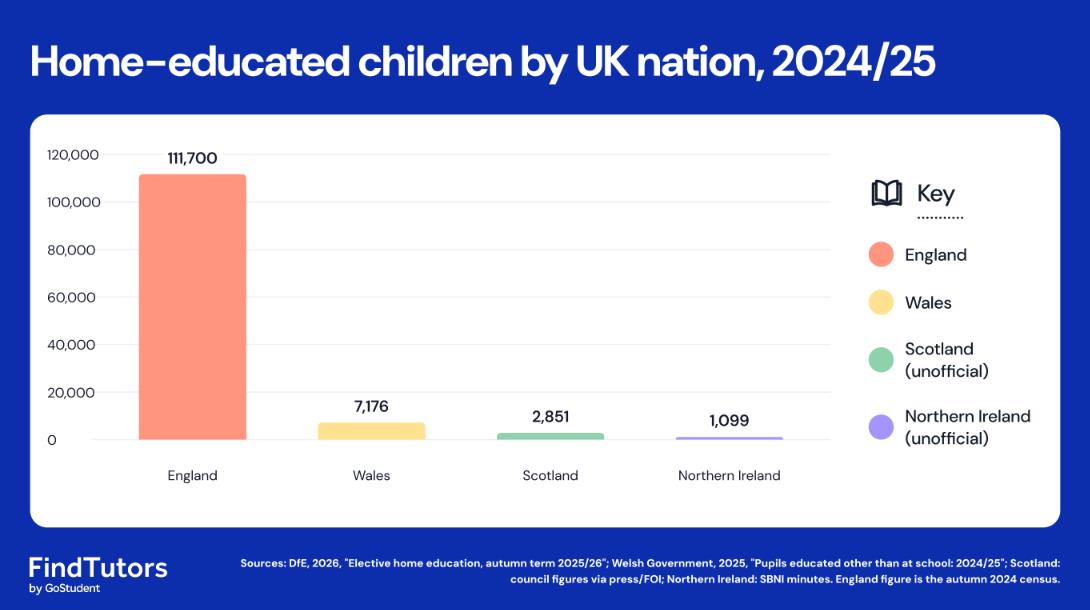
Add up the four nations and a very different picture emerges depending on where a family lives. England's total dwarfs the other three combined, while Wales, despite being a much smaller country, shows a home education rate that's surprisingly close to England's. Scotland and Northern Ireland sit at the other end of the scale entirely. Here's what each nation reports, and what the numbers actually suggest once you weigh them against each country's total school population.
|
Nation |
Children in home education |
Total school population |
% home educated |
Period |
|
England |
126,000 |
7,899,000 |
~1.6% |
Autumn 2025 / Jan 2025 census |
|
Wales |
7,176 |
~469,824 |
~1.5% |
2024/25 academic year |
|
Scotland |
~2,851 |
695,923 |
~0.4% |
2024/25 |
|
Northern Ireland |
~1,099 |
~324,412 |
~0.3% |
April 2025 / Oct 2024 census |
|
Sources: England and Wales school populations and home education figures, Department for Education and Welsh Government (official). Scotland school population, Scottish Government (official); Scotland home education figure, council-reported via press/FOI requests. Northern Ireland school population, NISRA/Department of Education (official, primary and post-primary only); Northern Ireland home education figure, Safeguarding Board for Northern Ireland minutes. Percentages calculated by FindTutors by dividing each nation's home education figure by its school population from the same or nearest period. |
- England and Wales sit almost neck and neck once measured as a share of their own school populations, around 1.5 to 1.6%, despite England's raw total being over 17 times larger,
- Scotland and Northern Ireland's shares are roughly a quarter of England and Wales's, even though their absolute numbers have grown at a similar or faster pace year-on-year,
- The gap between the two pairs of nations is wide enough that it's unlikely to be explained by data quality alone, something structural, whether reporting culture, registration requirements, or genuine differences in uptake, appears to be driving it.
|
📋 Methodology note The percentages above are calculated by FindTutors, dividing each nation's home education figure by its total school census population from the same or nearest period. England and Wales's totals come from official DfE and Welsh Government school censuses. Scotland's total comes from the official Scottish Government pupil census, but its EHE figure is council-reported, not official. Northern Ireland's school total (primary and post-primary only, excluding pre-school and special schools) comes from NISRA/Department of Education, but its EHE figure comes from Safeguarding Board minutes, not an official series. Treat the Scotland and Northern Ireland percentages as indicative, not verified. |
Share your expertise, become a tutor
The year-on-year trend across the UK
Numbers on their own don't explain much, so it helps to look at what's driving the rise, not just the rise itself. Researchers and parliamentary briefings point to several overlapping factors: a lingering pandemic effect, a broader strain on school attendance and engagement across the UK, and structural pressures like SEND provision that show up in the home education figures too. None of these fully explain the trend alone, but together they help make sense of why every nation reporting data is moving in the same direction, even when the numbers themselves aren't directly comparable.
England (Department for Education, official, 2022 onward; Association of Directors of Children's Services surveys, non-official, pre-2022):
- ~54,656 children, spring 2020, just before COVID-enforced school closures (ADCS survey),
- 80,900 in autumn 2022 (first official DfE census),
- 92,000 in autumn 2023,
- 111,700 in autumn 2024,
- 126,000 in autumn 2025.
Wales (Welsh Government, official):
- 2,517 children known to be home educated in 2018/19, pre-pandemic,
- 7,176 in 2024/25,
- The home education rate rose from 1.6 per 1,000 pupils in 2009/10 to 15.3 per 1,000 pupils in 2024/25, a near tenfold increase over 15 years.
Scotland (council-reported via press/FOI requests, not an official national series):
- No aggregated national pre-pandemic total exists, only individual council figures, which analysis by The National found had more than doubled since 2019 in some areas,
- 2,222 children in 2023/24,
- 2,851 children in 2024/25.
Northern Ireland (Safeguarding Board for Northern Ireland minutes, not an official national series):
- 281 children in 2014/15, pre-pandemic,
- 710 in 2020/21,
- 808 in 2021/22,
- 907 in 2022/23,
- 1,099 in 2024/25.
What this trend tells us:
- England's own pre-pandemic ADCS estimate (~54,656) means the official DfE figure has grown by well over 100% in five years, even discounting the data-collection change, this is a genuinely large shift, not just better counting,
- Wales's rate data confirms the growth pattern didn't start with COVID, it was already building for a decade before the pandemic ever hit,
- Northern Ireland's numbers show the steepest proportional growth of all four nations, nearly quadrupling since 2014/15, even though its absolute totals remain the smallest in the UK,
- Scotland is the only nation where a genuine pre-pandemic national baseline simply doesn't exist, which is itself worth noting, it's a data gap, not a sign that growth started later there than elsewhere,
- The Institute for Public Policy Research frames rising home education as one symptom of a wider "school engagement crisis," pointing out that unauthorised absence, suspensions, permanent exclusions, and emotionally based school avoidance have all risen in England alongside EHE, rather than in isolation from it,
- Some commentary and case reports describe school attendance officers, in certain cases, advising families toward deregistration as an alternative to prosecution for unauthorised absence, a pattern documented anecdotally rather than through official statistics,
- Wales's move to introduce compulsory registration under the Children's Wellbeing and Schools Act 2026 means some of its future year-on-year increases may partly reflect better identification of children already being home educated, rather than new families choosing it.
Why are more families choosing home education?
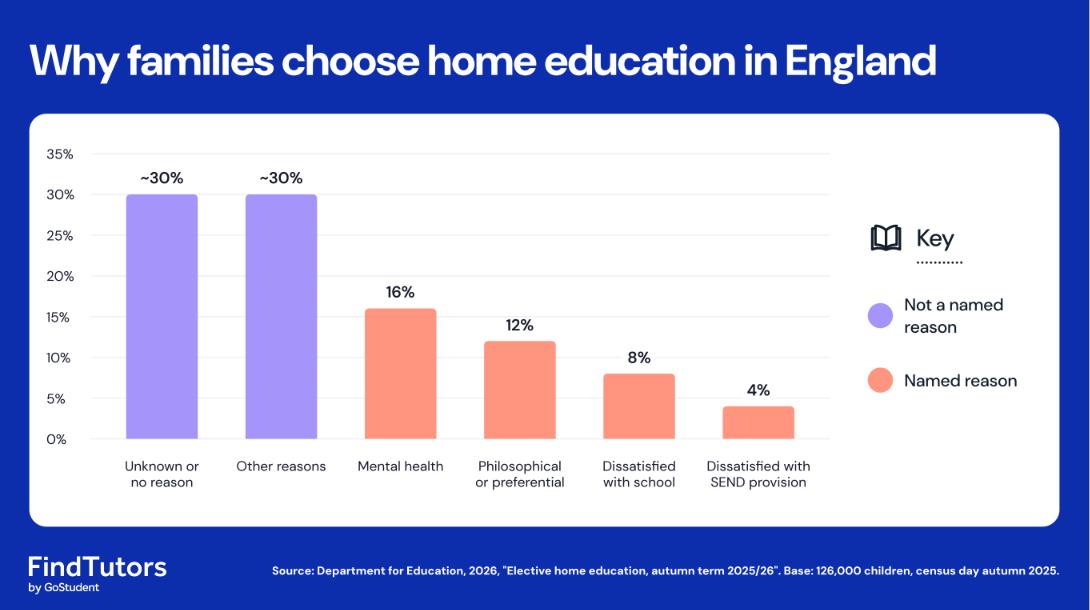
England is the only nation that publishes a breakdown of why families choose home education, and it's not based on a sample survey, every local authority in the country reports directly to the DfE, covering the full population of 126,000 children recorded in elective home education on census day, autumn 2025. That scale makes the breakdown worth reading closely. Here's what it actually shows, category by category.
|
Reason |
% of cases (autumn 2025) |
Change vs. previous year |
|
Mental health |
16% |
Up from 14% |
|
Unknown to LA / no reason given |
~30% |
Continued pattern |
|
Philosophical or preferential |
12% |
Up from 14% |
|
General dissatisfaction with school |
8% |
Up from 7% |
|
Dissatisfaction with SEND provision |
4% |
Up from 3% |
|
Other unspecified reasons |
~26% |
Not tracked at this detail |
|
Base: all 126,000 children recorded in elective home education in England on census day, autumn 2025 (full national administrative count, not a sample survey). Source: Department for Education, Elective Home Education, Autumn Term 2025/26. |
- 16% cited mental health: the single most commonly recorded reason, up from 14% the year before, and the clearest sign that home education is increasingly being used as a response to a child's wellbeing struggling within a school setting, rather than a lifestyle preference,
- 12% cited philosophical or preferential reasons: families choosing home education on principle, because they prefer a different educational approach, this share has actually fallen from 14% the previous year, even as overall numbers keep rising, meaning the growth is increasingly coming from other categories, not from this one,
- 8% cited general dissatisfaction with school: up from 7%, this covers families who withdrew because of broader unhappiness with how a school was run or how their child was being treated, without a more specific reason recorded,
- 4% cited dissatisfaction with SEND provision: up from 3%, a smaller share on paper, but one that's been rising steadily and lines up with the wider pattern already visible elsewhere in this data, home-educated children are more likely to have SEN support than the general school population,
- Almost 3 in 10 cases were recorded as "unknown to the local authority" or "parent did not provide a reason": this is the largest single category of all, larger than any named reason, and it says as much about gaps in the system's own record-keeping as it does about families' motivations,
- The remaining share is spread across smaller, unspecified categories: the four reasons above and the unknown category only account for around 70% of cases between them, the rest falls under categories the DfE hasn't broken out at this level of detail for autumn 2025,
- Two new primary reason categories were introduced from autumn 2025: local authorities have only just started reporting against them, and the DfE itself says too few were able to report reliably this term for a figure to be published, this term is essentially a trial run for better data in future releases.
|
A note on the other three nations: Wales, Scotland, and Northern Ireland don't publish a breakdown of why families choose home education. It's reasonable to assume similar drivers apply, mental health and preference for personalised learning are unlikely to be unique to England, but this can't currently be confirmed with data. |

Who is being home educated? England and Wales in focus
Behind the totals sits a clearer picture of who these children actually are, and it doesn't match the assumption of a single typical profile. Home-educated children skew slightly female, get progressively older as a share of the total, are more likely to have additional needs, and are less ethnically and linguistically diverse than the general school population. Demographic detail only exists for England and Wales, Scotland and Northern Ireland publish no characteristic-level data nationally, so this is necessarily a two-nation picture rather than a UK-wide one.
Sex:
- In England, 52% of home-educated children are female and 48% male, compared with a 49%/51% split in the general school population,
- Wales shows a sharper version of the same pattern: among 15-year-olds, the home education rate is 49.6 per 1,000 for girls versus 37.8 per 1,000 for boys.
Age:
- In England, the proportion of children in home education rises steadily with age, from 3% expected to be in year group 1 to 19% in year group 11,
- Wales shows the same upward pattern, its home education rate peaks specifically at age 15, reinforcing that this is a secondary-school phenomenon more than a primary-school one.
Additional needs (England only):
- 16% of home-educated children have an additional requirement of SEN support, versus 14% of the general school population,
- 7% have an education, health and care plan, versus 5% of the general school population.
Ethnicity and language (England only):
- 67% of home-educated children are of White ethnicity, broadly in line with the general school population (68%),
- Asian children are markedly under-represented, 4% versus 14% of the general school population,
- Only 4% have a first language other than English, compared with 21% of the general school population, a notably lower share.
Safeguarding status (England only):
- Just 1% of home-educated children are recorded as a "child in need," versus 3% of the general school population,
- Fewer than 0.5% have a child protection plan or are a looked-after child, both lower shares than the general school population.
So who is being home educated?
Based on what England and Wales's data actually shows, the typical profile leans slightly female, skews older, teenagers far more than young children, and is somewhat more likely to have additional educational needs than a child in mainstream school.
At the same time, this population is less ethnically diverse and far less likely to speak English as an additional language than the general school population, and it doesn't show up as higher-risk on the safeguarding measures England collects.
None of this adds up to a single "typical" home-educated child, but it does paint a consistent picture: home education in England and Wales looks less like families opting out at random, and more like a pattern shaped by age, need, and circumstance, one that current data can describe with real precision in two nations, and barely at all in the other two.
Find an exam preparation tutor
What does the research say about wellbeing and home education?
There's an assumption that pulling a child out of school puts their wellbeing at risk. One of the only recent pieces of clinical research to actually test that assumption found the opposite pattern.
A 2026 study by Catherine Sunshine at Ulster University, published in the Journal of School Choice, had caregivers of 130 children aged 6 to 16 across the UK and Ireland complete a standardised clinical screening tool (the Pediatric Symptom Checklist). School-educated children in the sample showed notably higher psychosocial difficulty scores than home-educated children, and education type was the strongest predictor of those scores.
This is a small, caregiver-reported sample, not a nationally representative one, so it shouldn't be read as proof that home education is inherently better for wellbeing. But it's a useful piece of home education statistics in the UK research precisely because it challenges a widely held assumption that rarely gets tested directly.
What does home education actually cost?
Home education is often framed as a way to save money on school-related costs, but the reality is more layered than that. Families take on tutoring, materials, curriculum resources, and sometimes lost income, without the safety net of state school funding behind them. Some of these costs are well documented, others simply aren't tracked by anyone. Below is what's actually known, what's estimated, and what it can look like in practice for a real household.
How these figures were sourced
- Official government and research-body sources (Department for Education, Welsh Government, Child Poverty Action Group): used wherever a figure is a published, methodologically documented statistic,
- First-party FindTutors data (UK Private Tuition Price Report 2026): used for tutoring costs specifically, based on 38,602 real tutor listings,
- Published exam centre fee schedules: used for exam entry costs, these are real, publicly listed prices from UK exam centres and awarding bodies, not government statistics, but verifiable and current,
- FindTutors estimates: used only where no official UK body publishes a figure, specifically for general home education materials and resources. These are our own indicative ranges, compiled by cross-referencing publicly available UK home education cost guides and curriculum providers as of September 2026, not verified statistics.
What the law actually says about who pays
- The Department for Education's own Elective Home Education guidance states plainly that parents "must be prepared to assume full financial responsibility for the child's education,"
- The same guidance explicitly names lost income as a foreseeable cost if a parent stays home to teach, this isn't compensated in any way,
- Local authorities can offer discretionary support, most commonly toward exam fees, but there's no entitlement to it, support varies by area and isn't guaranteed.
What school itself costs
|
Level |
Minimum annual cost of sending a child to school (2024 prices) |
|
Primary |
Just over £1,000 |
|
Secondary |
Around £2,275–£2,300 |
| Source: Child Poverty Action Group, "The Minimum Cost of Education in the UK" (May 2025). |
How these figures were calculated: this isn't a survey of what parents actually spend, it's built using the Minimum Income Standard (MIS) methodology, run by Loughborough University's Centre for Research in Social Policy since 2008. Groups of members of the public are asked, through structured focus groups, to agree what a child needs to participate fully in school life without being excluded or singled out. Researchers then price that agreed "basket" each year. For education specifically, the basket already bundles together uniform and PE kit, technology and devices, food during the school day (whether packed lunch or school meals), school trips (one residential trip at primary level, educational outings and an end-of-year trip at secondary), and subject-specific costs like art and design materials. This is a single, all-inclusive figure, not one line item among several, which matters for the comparison later in this section.
Tutoring costs: what the data actually shows
|
Format |
National median rate |
|
In-person |
£20/hour |
|
Online |
£24/hour |
| Source: FindTutors UK Private Tuition Price Report 2026, based on 38,602 tutor listings across 30 subjects and 20 UK cities. |
For a home-educating family, tutoring isn't an occasional top-up, it's a recurring weekly commitment covering several subjects at once. The report's own worked example: Primary School support (£25/hr), Maths (£20/hr), and French (£22/hr), one lesson per week each across a 39-week year, adds up to over £2,500 annually at in-person rates alone. Running those same three subjects online adds a further £450+ a year, since the £4/hour online premium compounds across each subject.
Hidden expenses to consider
1. Exam fees.
Unlike school pupils, home-educated children sitting GCSEs or A-Levels must register as private candidates and pay to sit each exam themselves. Published UK exam centre fee schedules for 2026/27 show a typical GCSE subject costs around £250 at the standard entry rate, plus a roughly £30 booking and administration fee, so close to £280 per subject, with some subjects running considerably higher. A-Level entries are typically charged per paper rather than per subject, at around £140 per paper, and most A-Level subjects have multiple papers. A family with a child sitting five or six GCSEs in one year could realistically be looking at £1,400–£1,700 in exam fees alone, a cost school-educated families never see directly, since it's absorbed by the school.
2. Loss of income.
As the DfE's own guidance acknowledges, this is real, but there's no government or academic survey that quantifies it nationally, it depends entirely on the parent's prior earnings, hours reduced, and how long the arrangement lasts. We haven't put a figure on this in any total below, it needs to be estimated individually by each family based on their own circumstances.
3. Cost of learning resources.
This varies enormously depending on approach. Free, UK-produced curriculum resources exist, including nationally recognised ones covering core subjects, and cost nothing beyond a printer and paper. Paid alternatives, structured online schools, workbook series, subject-specific literature for children, and stationery, can range from roughly £500 to £4,000+ a year, per our own FindTutors estimate, depending on how much of the approach is free versus paid. No government or academic body tracks this spending directly, so treat it as a planning guide, not a verified figure.
4. "Saved" costs, and why they're not really extra savings.
It's tempting to list uniform, school meals, and daily transport as money a home-educating family "saves." In practice, these are already priced into the CPAG school-cost figure above as one bundled total, not separate charges. So the honest way to frame it isn't "home education saves you £X on uniform," it's that home-educating families swap that entire bundled cost for a different set of costs, tutoring, materials, and exam fees, rather than avoiding cost altogether.
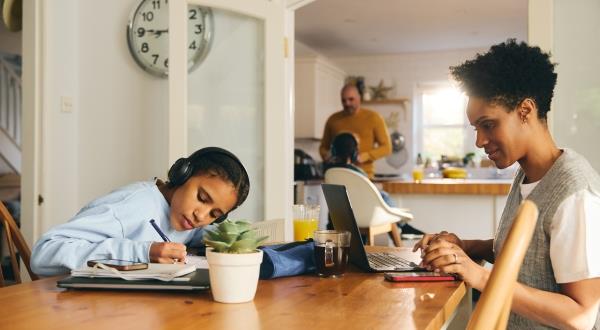
Homeschooling in the UK is only as cheap as you choose to make it
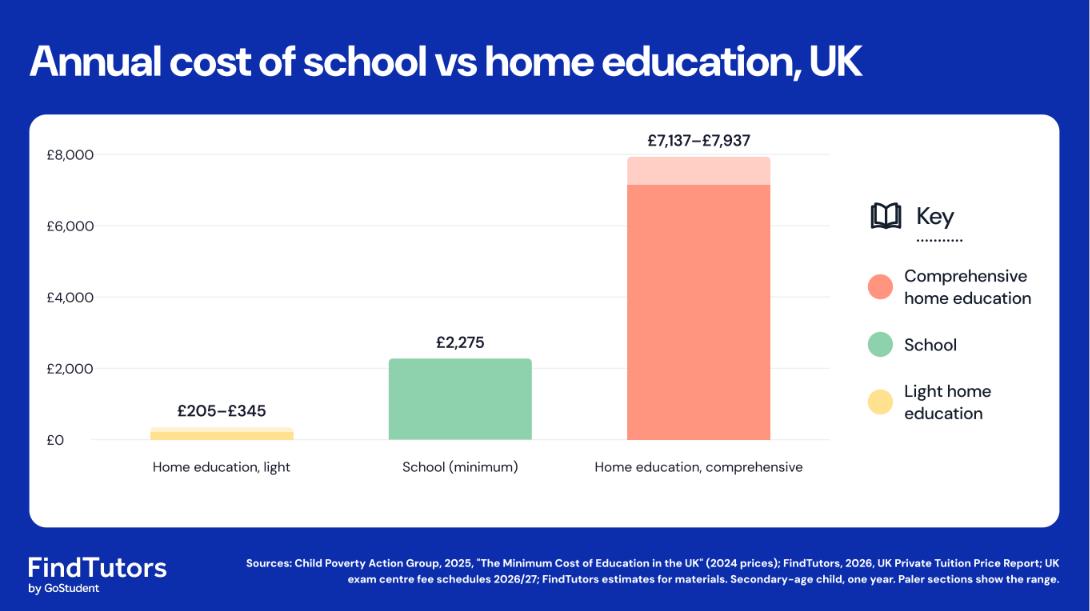
Put the pieces together, and it becomes clear there's no single "cost of home education," it's a spectrum, and where a family lands on it is almost entirely a matter of choice. Here's a side-by-side built from the figures above, comparing school against three realistic home education approaches, for a secondary-age child over one year.
To see where those totals actually come from, here's each approach broken down line by line.
School (CPAG minimum), secondary-age child
| Item | Weekly cost | Annual cost | What's included |
| School lunches | £20.35 | £793.71 | Lunches for 39 school weeks |
| Lunch box and water bottle | £1.01 | £52.44 | One lunch box, one water bottle |
| School uniform and shoes | £8.07 | £420.71 | Blazer, tie, PE kit, socks, two pairs of shoes per year |
| School bags | £0.56 | £28.97 | Backpack and PE bag |
| Transport | £7.48 | £390.00 | 39 weeks of getting to and from school |
| School trips | £1.92 | £100.00 | Educational outings during the year |
| Technology | £2.61 | £136.33 | Laptop and headphones for schoolwork |
| School charity days | £0.29 | £15.00 | Non-uniform days, fundraising events |
| Subject materials | £2.30 | £120.00 | Ingredients and materials for food tech, DT, etc. |
| School prom | £0.47 | £24.28 | End-of-year celebration |
| Other costs | £3.71 | £193.33 | Mobile phone, stationery, and general extras |
| Total | £48.76 | £2,274.77 |
| Source: Child Poverty Action Group, "The Minimum Cost of Education in the UK" (May 2025), Appendix 1, 2024 prices. |
This figure is worth sitting with for a moment. School is free at the point of access, but it isn't free to participate in, and food and technology, not uniform, are now the two biggest drivers of this total.
Home education, light approach
| Item | Weekly cost | Annual cost | What's included |
| Curriculum resources | £0 | £0 | Free, publicly available UK curriculum resources only |
| Printer | N/A (one-off) | £15.00 | A basic household printer |
| Ink and paper | £1.29 | £50.49 | Printer ink and paper for one secondary-age pupil |
| Stationery and notebooks | £1.03–£2.05 | £40–£80 | Pens, notebooks, folders, general supplies |
| Workbooks and reading material | £2.56–£5.13 | £100–£200 | Occasional paid workbooks or subject-specific books |
| Tutoring | £0 | £0 | Not used in this approach |
| Exam entries | £0 | £0 | No exams sat this year |
| Total | - | ~£205–£345 |
Assumes the family already owns a suitable device with internet access.
This is the bare floor, not a typical experience. At under a tenth of the school figure above, this approach trades money for time and confidence: it only works if a parent can teach every subject directly, with no paid support to fall back on.
Home education, comprehensive approach (GCSE year)
| Item | Weekly cost | Annual cost | What's included |
| GCSE Maths tutoring | £25.00 | £975.00 | One online lesson per week, 39 weeks |
| GCSE English tutoring | £23.50 | £916.50 | One in-person lesson per week, 39 weeks |
| Science tutoring | £27.50 | £1,072.50 | One in-person lesson per week, 39 weeks |
| French tutoring | £22.00 | £858.00 | One in-person lesson per week, 39 weeks |
| Structured online course | N/A (one-off) | From £299.00 | One subject's course materials, one example UK provider |
| Exam entries | N/A (one-off) | £1,680.00 | 6 GCSE subjects as a private candidate, incl. booking fees |
| Materials and resources | £30.77–£51.28 | £1,200–£2,000 | Revision guides, stationery, subject-specific supplies |
| Device and software | N/A (one-off) | £136.33 | Laptop and software for schoolwork |
| Total | - | ~£7,137–£7,937 |
This is where home education stops looking like a cost saving and starts looking like a second household bill. Once a family is tutoring several subjects and paying for exam entries themselves, costs school families never see directly, the total lands at more than three times the school figure, and tutoring alone accounts for over half of it.
What this means for the cost of tutoring specifically
Tutoring is the one cost that appears in every home education scenario above light, and it's worth being clear-eyed about its role: it isn't optional overhead, for most families going beyond free resources, it's the single largest line item, often outweighing materials, exam fees, and technology combined. In the comprehensive table above, the four tutoring lines alone total £3,822.00, more than half the overall cost. Whether that's one subject a week or four, tutoring cost scales directly with how many subjects a family needs outside help with, and choosing online over in-person changes the total meaningfully too, given the national £4/hour online premium.
Home education isn't inherently cheaper or more expensive than school, it's a cost structure a family builds themselves, one subject, one resource, and one tutoring decision at a time. A family doing the bare minimum can spend a fraction of what school costs. A family replicating a fuller, tutor-supported curriculum can just as easily spend several times more.

What this means for families considering home education
Put together, the picture that emerges from this data isn't one story, it's several overlapping ones. England's own reasons data shows mental health (16%) and dissatisfaction with SEND provision (up to 4%) are both rising, and the demographic breakdown backs that up directly, home-educated children are more likely to have SEN support than the general school population. Whatever the specific reason behind a family's decision, home education means losing the built-in structure, and the qualified subject support, that a classroom normally provides. The cost section above makes clear that rebuilding that structure isn't free, tutoring is consistently the single largest cost line for families going beyond a purely resource-based approach, and it's a decision each family weighs against their own budget and circumstances.
A GoStudent motivation survey from January 2026 found a growing share of UK pupils turn to tutoring for motivation and confidence, not just exam catch-up, which matters just as much for a child learning outside a traditional classroom. That's backed by outcomes data too: GoStudent's independent tutoring effectiveness study, reviewed by Dr Takako Aikawa of MIT and surveying 2,616 parents and students across Europe, found three in four students improved by up to three grades with personalised tutoring, and 90% of those who improved academically also reported greater confidence.
None of this settles the wellbeing question either, the one recent UK/Ireland study on this found home-educated children scored better, not worse, on psychosocial measures, but on a small, caregiver-reported sample that can't be generalised. What the data does suggest, taken as a whole, is that home education tends to work best when a family treats it as something to build deliberately, reasons, resources, and support included, rather than a single decision made once and left alone.
What the UK home schooling statistics really add up to
The UK home education statistics picture in 2026 is one of steady, sustained growth in every nation that publishes data, with England alone recording 126,000 children in autumn 2025. But the numbers only tell part of the story. Behind them sit real gaps, in reasons recorded, in demographic detail, in funding, and in wellbeing research, that are just as revealing as the headline figures themselves.
What's clearer than the growth itself is that home education doesn't follow a single pattern, financially or otherwise. The cost comparison in this piece shows a family can spend a fraction of what school costs, or several times more, depending entirely on the choices they make about tutoring, resources, and exam entries. The demographic and reasons data tell a similar story: this isn't one typical family making one typical decision, it's thousands of different households responding to different pressures, from mental health to SEND provision to simple preference.
For families weighing up whether, or how, to approach home education, that variability is worth sitting with. The subjects, support, and structure a family chooses to build around their decision will shape both the experience and the cost far more than the decision to home educate itself.
Frequently asked questions about home schooling statistics in the UK
➕ How many children are home educated in the UK? |
|
England recorded 126,000 children in elective home education in autumn 2025 (DfE). Wales recorded 7,176 in 2024/25 (Welsh Government). Scotland (~2,851) and Northern Ireland (~1,099) don't have official national figures, so their numbers come from council reports and safeguarding board minutes rather than a verified national count. |
➕ Is home schooling legal in the UK without permission? |
|
Yes, in England, Wales, and Northern Ireland, parents don't need permission to home educate. In Scotland, if a child has already started school, parents need their local council's consent before withdrawing them. |
➕ Why do families choose home education? |
|
England's own data shows mental health (16%) and philosophical or preferential reasons (12%) as the two most cited factors, though almost three in 10 cases have no recorded reason at all. Other UK nations don't publish this breakdown. |
➕ Do home-educated children have worse wellbeing than school-educated children? |
|
A 2026 UK/Ireland study (Sunshine, Ulster University) found the opposite in its sample, school-educated children showed higher psychosocial difficulty scores than home-educated children. The sample was small (130 children) and caregiver-reported, so it isn't conclusive either way. |
➕ Does the government fund home education? |
|
No. The DfE's own guidance states parents assume full financial responsibility, including lost income if a parent stays home to teach. Local authorities may offer discretionary support, most commonly toward exam fees, but there's no guaranteed funding. |
➕ Do parents get money for homeschooling in the UK? |
|
No, not as standard. The Department for Education's own guidance states that parents "must be prepared to assume full financial responsibility" for home education, including lost income if a parent reduces their working hours to teach. Local authorities can offer discretionary support, most commonly toward exam fees, but there's no automatic entitlement, and it varies significantly by area. |
➕ Is it expensive to homeschool in the UK? |
|
It depends entirely on the approach a family chooses. A light approach using only free curriculum resources can cost as little as £205–£345 a year, while a comprehensive approach with multiple tutored subjects and GCSE exam entries can run to £7,000–£8,000 or more. For comparison, sending a child to school costs a minimum of around £2,275–£2,300 a year, according to the Child Poverty Action Group. Home education isn't inherently cheaper or more expensive than school, the cost depends on the choices a family makes around tutoring, resources, and exams. |
SourcesOfficial statistics and government sources🔗 Elective home education, autumn term 2025/26 — Department for Education Legal sources🔗 Education Act 1996, Section 7 — legislation.gov.uk Independent and peer-reviewed research🔗 Happy at Home? A comparative study of psychological well-being and psychiatric risk in home- and school-educated children — Sunshine, Journal of School Choice, 2026 Non-official national figures (Scotland and Northern Ireland)🔗 Home education statistics UK 2026: numbers, trends and reasons — council-reported figures compiled from press/FOI sources; not an official statistics body Pricing and market sources🔗 Exam Fees 2026/27: GCSE, A-Level & IGCSE Exam Costs for Private Candidates — published UK exam centre fee schedule FindTutors and GoStudent first-party data🔗 How much does a private tutor really cost in the UK in 2026? — FindTutors UK Private Tuition Price Report 2026, based on 38,602 tutor listings |
Did you like this article? Share it now
Statistics tutor in Barcelona Ciudad specalised in offering online lessons classes adapted to the needs of each student. My classes are designed to help you reach your goals.
Teaches Catalan, Spanish, Photography, Maths, All courses, History, Latin, German, English as a foreign language, English Language, Physics, GCSEs and A Levels for adults and French classes
Use our Smart Finder